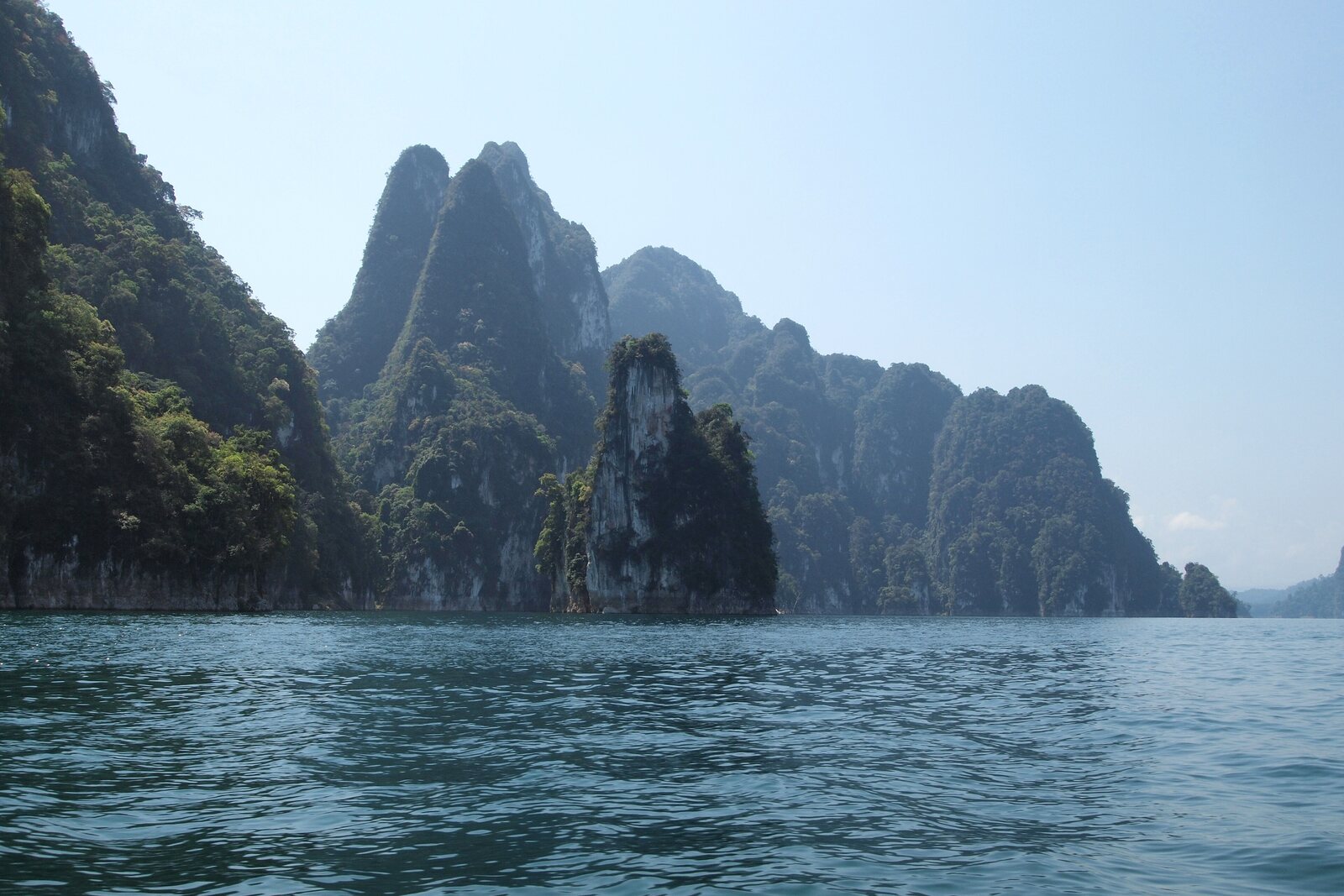
Khao Sok National Park & Cheow Lan Lake
Rainforest older than the Amazon, and at its centre a man-made lake of drowned karst reached only by longtail. We stay out on the water, not at the pier.
Where
Surat Thani
Best time
December to April, when the mornings are mistiest and the lake stays glass-flat.
Khao Sok is the oldest thing in this part of Thailand. The forest here has stood, unglaciated and largely undisturbed, for something on the order of a hundred and sixty million years, which makes it older by a wide margin than the Amazon. It is evergreen rainforest on limestone, and the karst towers rising out of it carry their own vegetation on ledges nothing can reach.
Cheow Lan Lake, at the park's eastern edge, is not natural and it is worth saying so. It was made in 1987, when the Ratchaprapha Dam flooded a system of forested valleys, and the spires standing out of the water are the tops of hills that were there before. Drowned trees still break the surface in the shallow arms.
Everything of interest happens at either end of the day. Gibbons call across the water before six; hornbills cross at height in the last hour of light.
Why the spires stand in water
Ratchaprapha Dam closed in 1987 and the reservoir behind it filled a system of valleys, leaving the limestone summits standing as islands. What look like sea stacks are hilltops; what looks like open water is a drowned watershed of some hundred and sixty square kilometres. Villages were moved, and wildlife with them, some of it successfully.
The consequence for a visitor is a lake with an unusually intricate shoreline — long arms running back between cliffs and dead-ending in bays where the forest comes down to the water and there is nowhere for a boat to be except yours. It is also why the surface is glass at dawn: no swell, no tide, and cliffs on every side.
Sleeping on the water, and what that involves
Accommodation on Cheow Lan is a raft house: a row of bamboo or timber cabins floating on drums, moored in a bay and reached only by longtail. Power is limited and often runs off a generator for a few hours in the evening. There is no road, no shop and, in most bays, no signal. The better raft houses have private cabins with proper beds and their own bathrooms rather than the shared arrangements at the budget end. You swim off the deck.
The reason to accept the trade is the hour before sunrise, when mist sits on the water at cabin height and the gibbons start up behind you. None of that can be reached from a hotel on the mainland.
What you will and will not see
Khao Sok holds elephants, tapir, clouded leopard and, on paper, tiger. In practice, over three days, what you see is gibbons — heard far more often than seen — langurs, macaques, hornbills and the occasional otter along the shoreline. Guides working the same bays daily know where the troops are, and a dawn run by longtail with the engine cut is the method that works.
Between roughly December and February the forest floor above the lake produces Rafflesia kerrii, a parasitic bloom the size of a dinner plate that smells of carrion and lasts a few days. It is a walk with a ranger, and it is never guaranteed.
How We Visit
Our way in
We bring you in from Surat Thani or across from the Andaman coast by road, then out from the dam pier by private longtail rather than the shared boat — which matters mainly because it lets us leave when the light is right rather than when the boat is full. Two nights on the lake is the shape that works: an afternoon exploring the arms, a dawn safari with a park guide who knows where the troops are, a cave or a jungle walk on the middle day. We book raft houses with private cabins and bathrooms, and we tell you plainly what the power arrangements are.
Questions
What travellers ask
Is Cheow Lan Lake natural?
No. Cheow Lan is a reservoir, created in 1987 when the Ratchaprapha Dam flooded a system of forested valleys inside Khao Sok National Park. The limestone spires standing in the water are the tops of hills that predate the lake, and drowned trees still break the surface in the shallower arms. The rainforest around it, by contrast, is among the oldest on earth.
How many nights do you need at Khao Sok?
Two nights on the lake, in most cases. One night gives you a single dawn with a long journey either side of it. Two gives you a full day on the water, a proper jungle or cave walk, and a second chance at the morning if the first comes up grey. Beyond three nights the days begin to repeat themselves unless you are there specifically for wildlife.
When is the best time to visit Khao Sok?
December to April, when the mornings are mistiest and the lake stays flat. Khao Sok is rainforest, so rain is possible in any month, and the wettest stretch runs roughly May to November — which is also when the forest is at its most alive and the waterfalls run hardest. Some caves close in the wet season for safety. The Rafflesia flowers around December to February.
Journeys That Include This
Ask about Khao Sok National Park & Cheow Lan Lake
It sits inside a journey we already run, and it fits just as easily into one written from scratch around your dates.
Nearby