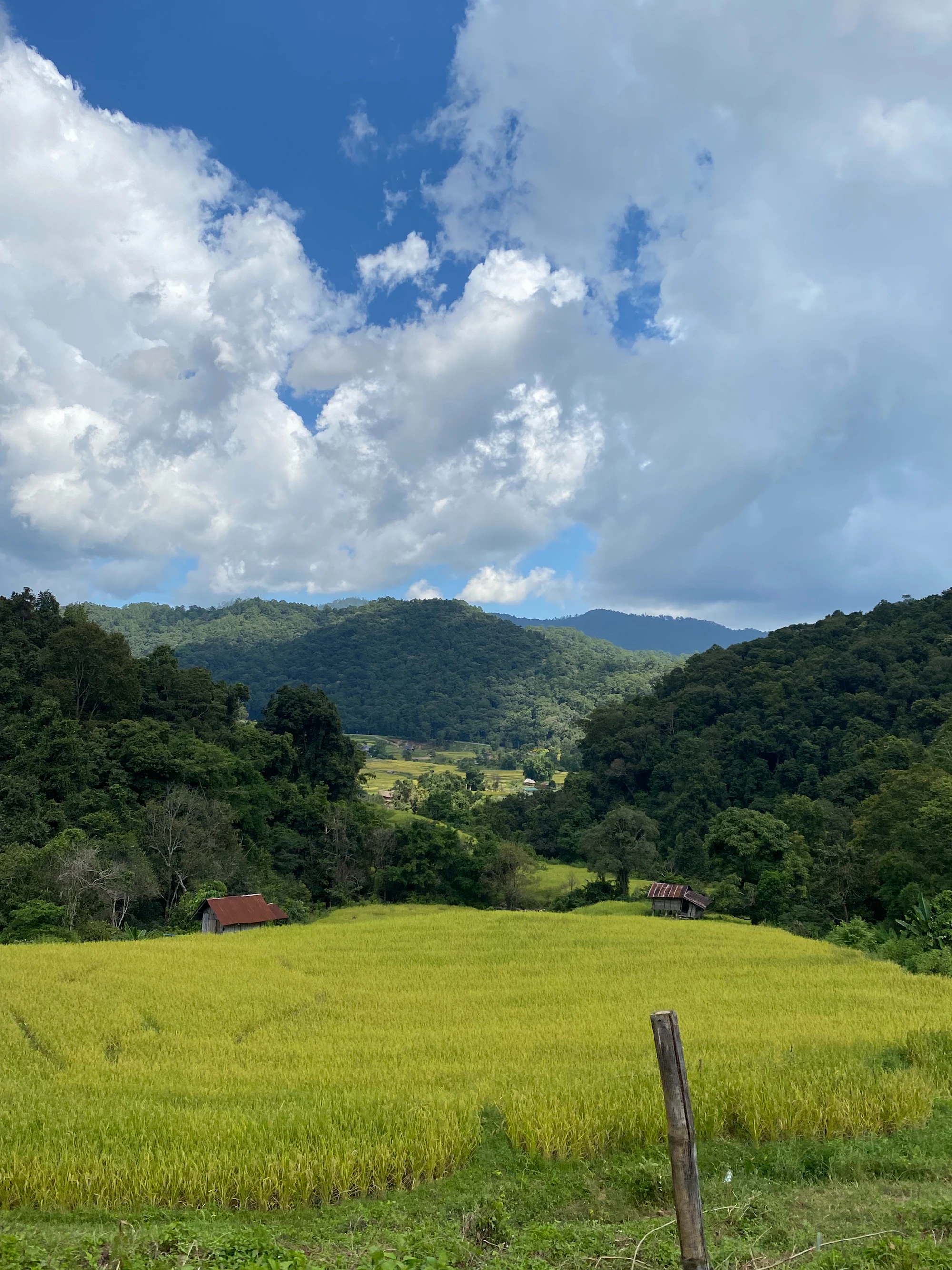
Pai & the Mae Hong Son Loop
Six hundred kilometres of mountain road and 1,864 counted curves, taken over three or four days with a private car and a driver who knows them.
Where
Mae Hong Son
Best time
November to February, when the mountain air is cool and the road is dry.
The loop runs from Chiang Mai north-west to Pai, on to Mae Hong Son near the Burmese border, and back east through Mae Sariang: some six hundred kilometres of switchback through the highest country in Thailand. The road signs count the curves, and the number they arrive at, 1,864, has become the route's identity.
What the number does not convey is the ethnic complexity of the country it passes through. This is Shan and Karen ground as much as Thai, with Lisu and Lahu villages on the ridges and a Yunnanese Chinese tea settlement almost on the border. The architecture changes as you go: Burmese-style temples with tiered tin roofs, teak monasteries, a lake in the middle of a provincial capital that looks nothing like the rest of the country.
Driven fast it is an ordeal. Driven over four days it is the best road journey in Thailand.
The 1,864 curves, and what they cost
The corners are relentless rather than dramatic — tight, banked, and continuous for hours at a stretch. Anyone in the party who travels poorly will know about it within the first ninety minutes out of Chiang Mai, and no amount of scenery compensates.
There are two honest ways to handle this. The first is pacing: short driving legs, frequent stops, front seats, and no attempt at Chiang Mai to Mae Hong Son in a day. The second is to remove a leg altogether and fly the Chiang Mai to Mae Hong Son sector, which takes well under an hour, then drive the loop as an out-and-back from there. We will ask about this before we plan, not afterwards, because it changes the whole shape of the itinerary.
What the road is actually for
Tham Lod, near Soppong, is a river cave you enter on a bamboo raft with a guide carrying a lantern; at dusk several hundred thousand swifts pour back into the entrance in a column. Ban Rak Thai, on the Myanmar border, is a Yunnanese village of mud-walled houses around a reservoir, growing and drinking its own tea. Mae Hong Son itself has a lake in the middle of town with two Burmese-style temples on the shore, and mist in it most cool-season mornings.
Pai has become a small resort town and divides opinion. We treat it as an overnight rather than a destination, and put the day's hours into the hot springs, the valley and the Shan villages around it instead.
Three days or four
Three days is the minimum that is not a forced march: Chiang Mai to Pai, Pai to Mae Hong Son, and the long southern leg home through Mae Sariang. It works, and the last day is long.
Four is better. The extra night goes to Mae Hong Son, which gives you a morning on the lake, the border tea village, the bamboo bridge across the paddy at Su Tong Pae, and a day with no transfer in it at all. Five allows a night in Mae Sariang and turns the southern leg from an endurance into a drive. We would rather sell you four unhurried days than three efficient ones, and we will say so.
How We Visit
Our way in
A private car and a driver who runs this road regularly, not a self-drive and not a minibus. We fix the overnight stops so that the driving legs stay short and the afternoons stay free, and we hold the long southern leg for a day when nobody has to be anywhere. Where motion sickness is a factor we fly one sector rather than pretend it will be fine. Village stops are arranged through people we have long relationships with and are treated as visits rather than viewings. Where elephants come into it, we use observation-only sanctuaries: no riding, no shows, no chains.
Questions
What travellers ask
How many days do you need for the Mae Hong Son loop?
Four is the right answer; three is the minimum. Three days covers Chiang Mai to Pai, Pai to Mae Hong Son and the long southern return through Mae Sariang, with a demanding final leg. A fourth day gives Mae Hong Son a full morning, the border tea village at Ban Rak Thai and a day without a transfer. Five turns the southern leg into a pleasure rather than a push.
Is the Mae Hong Son loop difficult to drive?
It is sustained rather than technically hard: roughly six hundred kilometres of continuous tight switchbacks, famously counted at 1,864 curves. The surface is generally good. The difficulty is fatigue and motion sickness, not danger. We use a private car with a driver who runs the route regularly, and where anyone in the party travels poorly we fly the Chiang Mai to Mae Hong Son sector instead of driving it.
When is the best time to drive the Mae Hong Son loop?
November to February, when the mountain air is cool, the road is dry and the valleys hold morning mist. Avoid roughly February to April if you can: that is northern burning season, and the long ridge views the road exists for can be lost to haze for weeks. The rains, from June to October, make the surface greasy on the switchbacks and the landscape greener than at any other time.
Journeys That Include This
Ask about Pai & the Mae Hong Son Loop
We build it into a journey written from scratch around your dates, rather than fitting you to a fixed itinerary.
Nearby