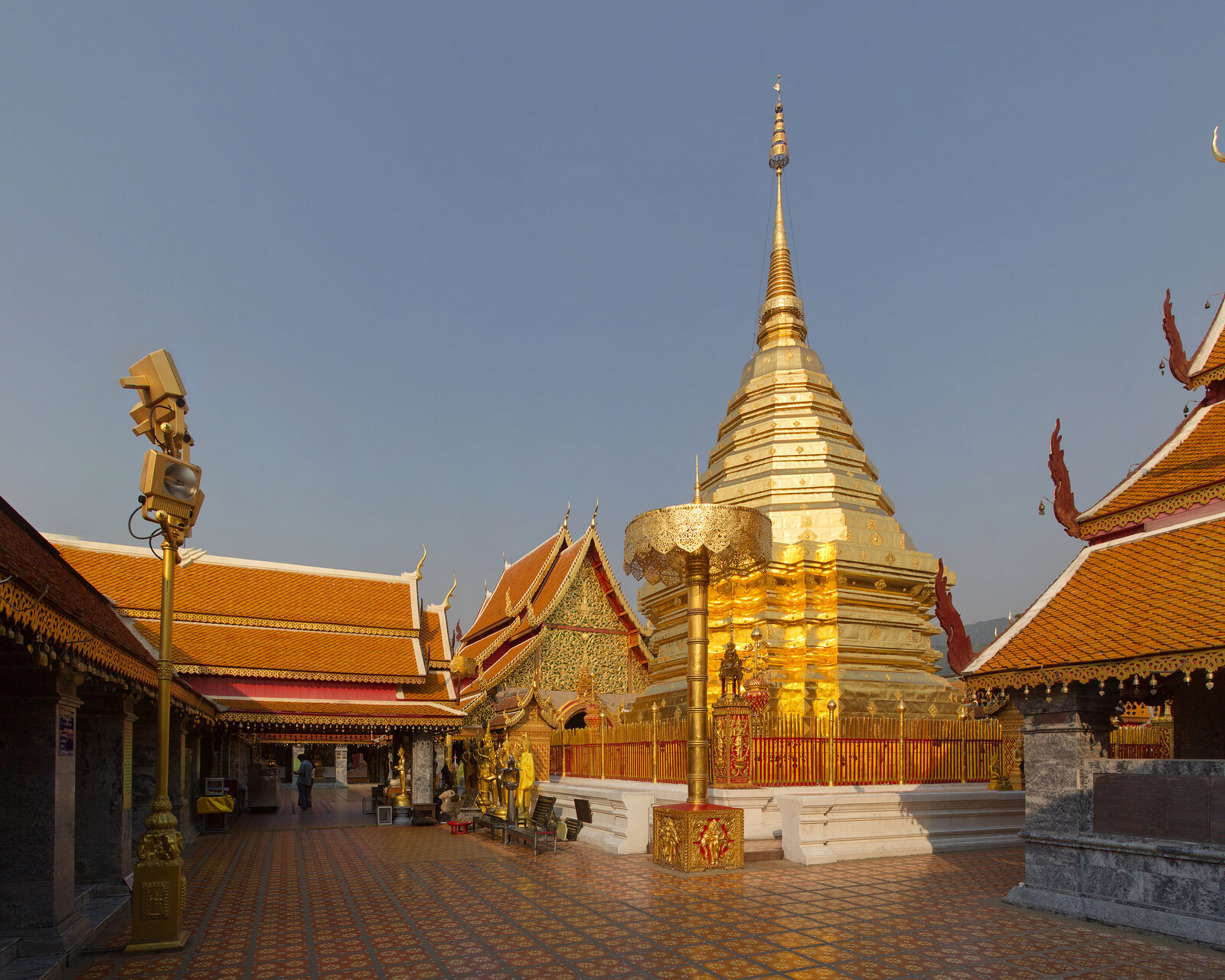
Wat Phra That Doi Suthep
The temple on the mountain above Chiang Mai, taken before seven, while the chanting is still under way and the mist has not left the trees.
Where
Chiang Mai
Best time
Before 07:00, in any month. The view over the city depends entirely on the haze.
The road up Doi Suthep leaves the city and climbs for a quarter of an hour through forest, and the temperature drops as it goes. At the top, three hundred and six steps run up between two long naga balustrades, their scales worn smooth by six centuries of hands. Above them stands the golden chedi that is Chiang Mai's defining silhouette, visible from the plain on a clear day and the thing half the province looks up at when it wants its bearings.
It is a working temple before it is anything else. Arrive at seven and the terrace belongs to people who have come to make merit rather than photographs: monks moving between the shrines, families circling the chedi three times with lotus and incense, the low double chant carrying flatly across the stone.
By ten the coaches have come up from the city and it is a different place. The difference costs nothing but an early start, and in our view it is the entire visit.
The white elephant that chose the mountain
The temple accounts for its own siting with a story, and the story is worth carrying up the hill with you. A relic of the Buddha was placed on the back of a white elephant and the animal let loose to find where it should rest. It climbed Doi Suthep, circled three times near the summit, trumpeted, knelt and died. The chedi was raised over the relic on that spot in the fourteenth century, under King Kuena of Lanna, and the terrace has been built outward around it ever since.
Whether you take the account as history or as an argument about how ground becomes sacred, it explains everything the site asks of you: the height, the long approach, the circling. Pilgrims still walk the chedi three times clockwise. It is not decoration; it is the story being repeated.
Reading the terrace before the crowds
Shoes come off at the inner terrace, and the marble is cold at that hour. The chedi is sheathed in gilded copper plate and hung with tiered umbrellas at its four corners; the cloister around it holds bronze bells that pilgrims strike in passing, murals of the Buddha lives, and a copy of the Emerald Buddha whose original left Chiang Mai centuries ago and never came back.
The city viewpoint sits on the outer terrace, below the shrine rather than above it, which is the right order: the temple first, the view as an afterthought. Shoulders and knees stay covered throughout. For anyone who would rather not take the naga staircase, a small funicular runs up beside it, and using it costs you nothing but the walk.
What the burning season does to the view
From roughly February to April the northern valleys fill with smoke from agricultural burning, in Thailand and across the borders, and Chiang Mai sits in a bowl that holds it. In a bad week the city below the terrace simply is not there. The temple is unaffected, the forest on the way up is at its most atmospheric in that flat grey light, and the morning chant does not care about air quality.
We would rather tell you this before you book than explain it on the terrace. If clear long views matter to you, we will steer the journey to November through January and say so plainly. If your dates are fixed, we build the day around what the mountain will actually give you.
How We Visit
Our way in
We leave the old city in the dark with a private car and driver, so that we are on the terrace as the temple opens rather than queueing behind coaches on the mountain road. Your guide is a Lanna specialist who can read the murals and the inscriptions rather than recite a headcount of steps, and who knows when to stop talking during the chant. We descend as the tour traffic climbs, and take breakfast back in the moat quarter. Where air quality is poor we say so in advance and reshape the morning rather than sell you a view that is not there.
Questions
What travellers ask
What time should you visit Wat Phra That Doi Suthep?
Before seven in the morning. The temple opens early for merit-making, and the first hour belongs to worshippers and monks rather than visitors, with morning chanting under way on the terrace. Coach groups begin arriving from Chiang Mai mid-morning and the atmosphere changes completely. The drive up takes around forty minutes from the old city, so a dawn departure is what makes the early arrival possible.
How many steps are there at Wat Phra That Doi Suthep?
Three hundred and six, flanked by two long naga balustrades that run the full length of the staircase. The climb is steady rather than steep and takes most people around five minutes. A small funicular runs alongside for anyone who would rather not walk up, and it delivers you to the same terrace. Shoulders and knees must be covered, and shoes come off before the inner terrace.
Is Chiang Mai hazy at Doi Suthep in March?
Often, yes. Roughly February to April is northern burning season, when agricultural smoke settles into the Chiang Mai valley and the view from the temple terrace over the city can disappear entirely. The temple itself is unaffected and the forest road is beautiful in the flat light. If clear long views matter to you, November to January is the honest answer.
Journeys That Include This
Ask about Wat Phra That Doi Suthep
It sits inside a journey we already run, and it fits just as easily into one written from scratch around your dates.
Nearby