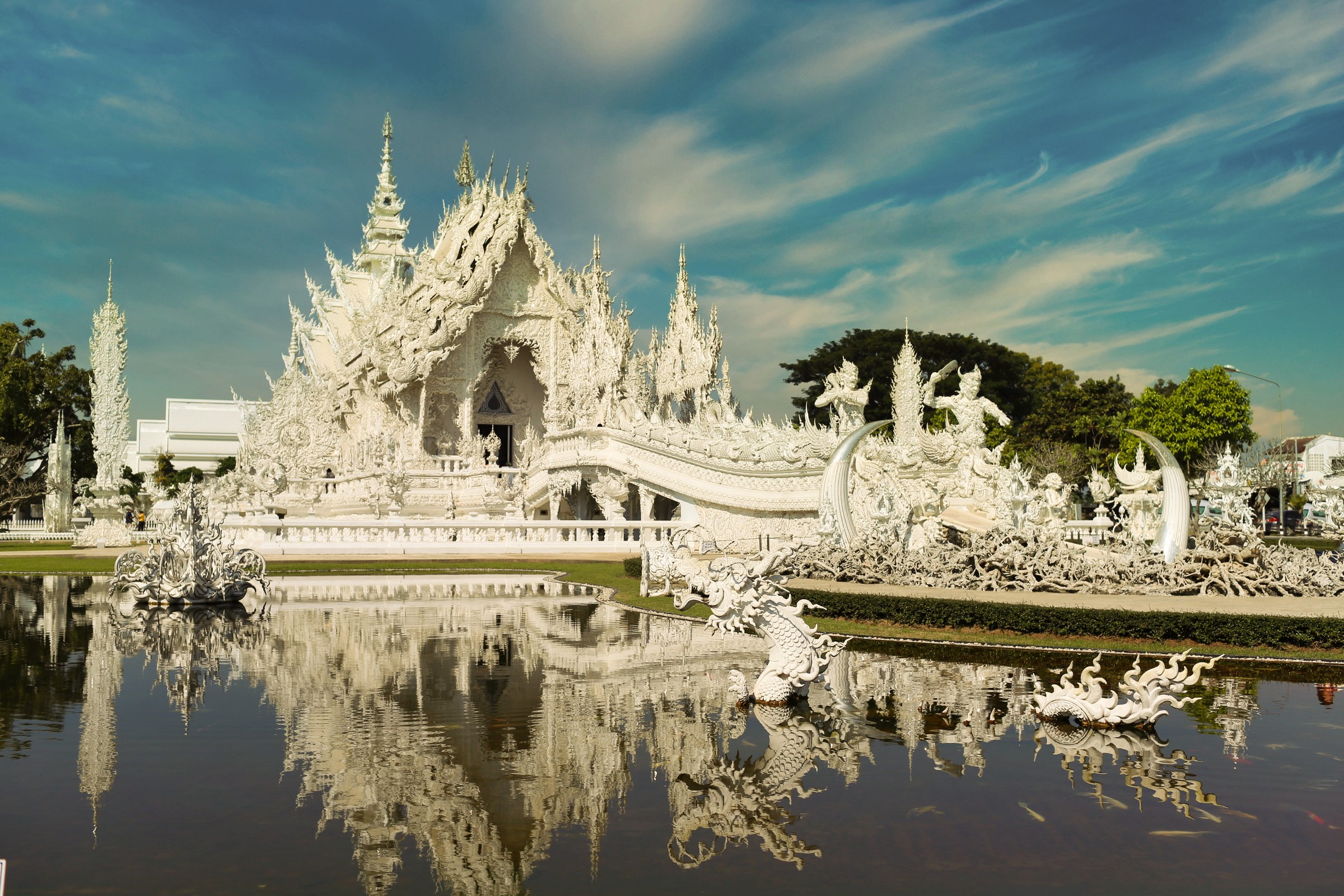
Wat Rong Khun
The White Temple
Chalermchai Kositpipat's white temple is a private artwork still being built, not an ancient site, and the hour you arrive decides what it is like.
Where
Chiang Rai
Best time
At opening. It is a two-hour drive from Chiang Mai, so we usually start in the dark.
Wat Rong Khun is the work of one man. The artist Chalermchai Kositpipat bought the ruin of a small local temple in the 1990s, funded its rebuilding himself, and has been extending it ever since with a stated intention that it will not be finished in his lifetime. It is therefore not a monument in the usual sense but a working studio at architectural scale, and it should be read that way.
The whole ensemble is white, inset with fragments of mirrored glass that break the sun into pieces across every surface. You approach across a bridge over a field of hands reaching up out of the ground. Inside, the murals abandon anything you might expect from a Thai temple in favour of a contemporary catalogue of human appetite and violence, painted with obvious skill and no restraint whatsoever.
It is a serious piece of work, and by noon it is genuinely crowded.
What the white plaster is actually made of
The building is plaster over concrete, set with thousands of small mirrored glass chips. The reading the artist has given is direct: white for the purity of the Buddha, the mirrors for wisdom throwing light back into the world. In practice the effect changes hour by hour. In early light it reads as chalk and shadow, at midday it is close to painful, and after rain the whole thing doubles into the reflecting pool.
The fine white filigree, the mythological creatures, the tapering ornament that looks like frost — all of it is ornamental sculpture rather than restoration of anything historic. Approached as contemporary art it holds up. Approached as an antiquity it will confuse you.
The bridge, the hands and the golden building
The route in is a designed sequence. You cross a bridge over hundreds of outstretched arms, which stand for desire and the hell realms, and there is no path back the way you came; the crossing is meant to be one-directional, out of craving and toward the shrine. The gate before it is flanked by two guardian figures deciding who passes.
Beside the white ubosot stands a lavishly gilded building. It is the lavatory, and the joke is theological: gold for the body and its concerns, white for the mind. Very few visitors are told this, and it reframes the whole site once you know it. The interior murals continue the argument in a modern idiom that some visitors find bracing.
Why midday is the wrong time
Wat Rong Khun sits a short drive south of Chiang Rai and roughly three hours by road from Chiang Mai, which puts the arrival of the day-tour coaches at around eleven. From then until mid-afternoon the bridge has a queue, the reflecting pool has people in it, and the quiet the place is actually designed for is gone.
At opening there may be a handful of others. The light is low and side-on, the mirrors are doing their work, and you can stand still. This is not a marginal difference. It is the difference between an artwork and a photograph queue, and it is the single reason we insist on the early departure.
How We Visit
Our way in
We leave Chiang Mai before dawn with a private car and driver, or stay the previous night in Chiang Rai where the journey allows it, so that we are at the gate as it opens rather than behind three coaches. Your guide can talk about Chalermchai as a painter and about where the iconography comes from, which is a different conversation from a walk-round commentary. We pair the morning with the Blue Temple across the city rather than racing four sites, and we build in enough time to simply stand and look, which is what the place rewards.
Questions
What travellers ask
Is the White Temple worth visiting?
Yes, provided you go early and understand what it is. Wat Rong Khun is a contemporary artwork by Chalermchai Kositpipat, begun in the late 1990s, privately funded and still unfinished, rather than a historic temple. Visitors who expect an antiquity are often disappointed; visitors who come for a large-scale piece of living Thai art are not. By late morning it is genuinely busy, which changes the experience considerably.
Who built the White Temple in Chiang Rai?
The Thai artist Chalermchai Kositpipat, who bought the derelict original temple on the site in the 1990s and rebuilt it at his own expense as an ongoing work. He has said openly that it will not be completed in his lifetime, and construction continues. That is why the site reads as a studio rather than a monument, and why the murals inside carry contemporary imagery rather than traditional temple scenes.
What time should you arrive at Wat Rong Khun to avoid the crowds?
At opening. The site is roughly three hours by road from Chiang Mai, so the first coach groups arrive around mid-morning and the bridge is queueing by late morning. Being there in the first hour means low side light on the mirrored glass, a clear reflecting pool and room to stand still. Either start from Chiang Mai in the dark or overnight in Chiang Rai.
Journeys That Include This
Ask about Wat Rong Khun
It sits inside a journey we already run, and it fits just as easily into one written from scratch around your dates.
Nearby