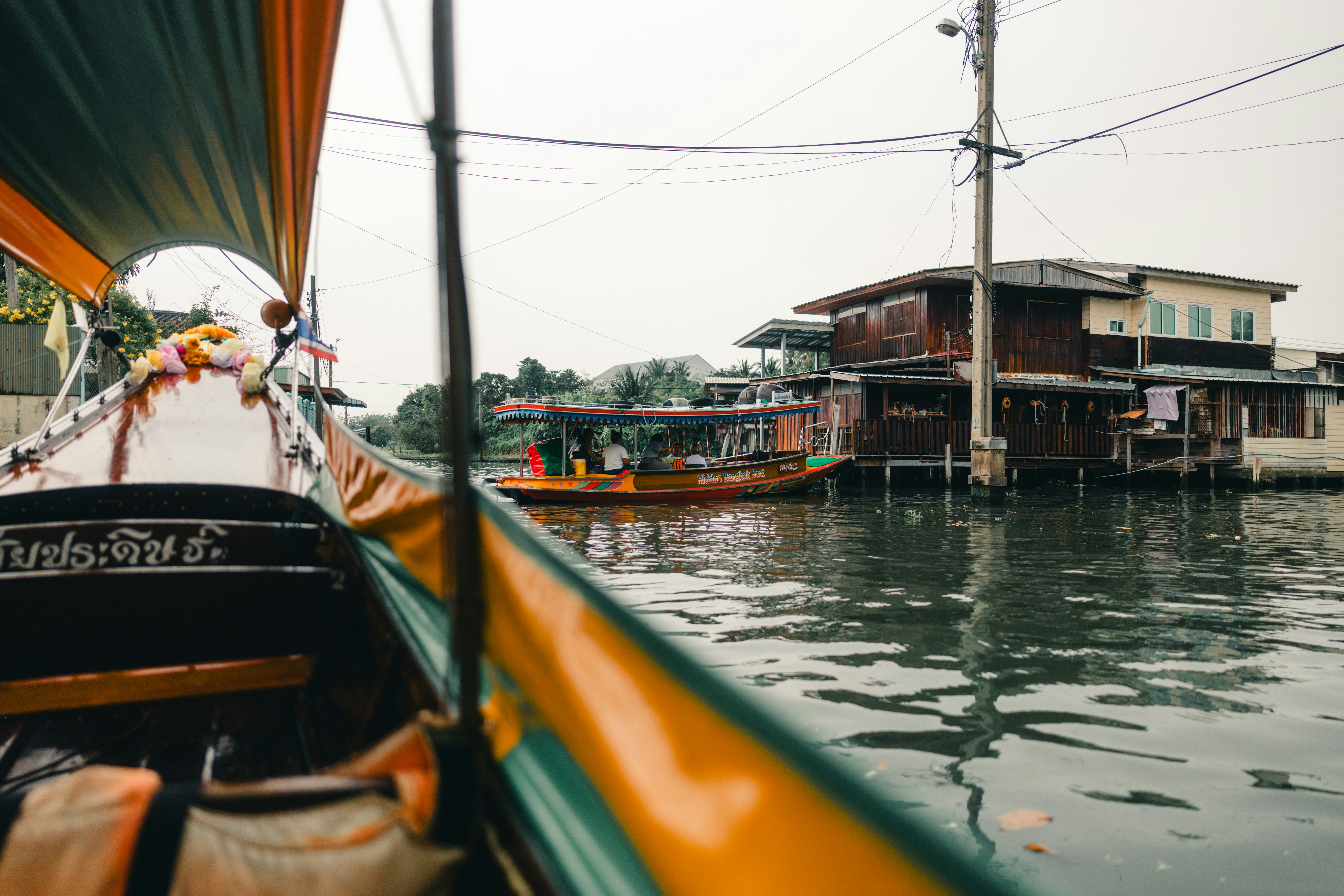
The Chao Phraya & Thonburi Canals
Bangkok was built on water, and the Thonburi klongs still work as streets — best entered by private longtail just after dawn, before the day-boats.
Where
Bangkok
Best time
Just after dawn, before the heat and the day-boats.
The two great canals of the Thonburi bank, Bangkok Yai and Bangkok Noi, are not canals at all in origin. They are the old course of the Chao Phraya. In the sixteenth century a shortcut was cut across a long meander to speed ships up to Ayutthaya; the current took the shortcut, widened it into the main river, and left the original loop behind as two quiet arms of water. Bangkok grew up along the straightened channel.
What remains on the loop is a working suburb that faces the water rather than the road. Stilt houses with the laundry over the rail, temple landings with stone steps down into the river, boatyards, a school jetty, a floating shop that comes to the door. Monitor lizards move along the banks with complete confidence.
It is twenty minutes from the hotel piers and organised on entirely different terms.
Why the longtail, and why so early
A hang yao — a long-tail — is a shallow wooden hull with a car engine mounted on a pivot at the stern and a propeller on the end of a long shaft. It is loud, and it draws almost nothing, which is the point: it goes where a tour barge cannot, up the smaller klongs and under bridges with a hand’s width to spare. Before about eight in the morning the canals are doing their own work — children to school, monks on the alms round taking food handed down from landings, produce moving. By ten the same water is carrying boats of visitors being shown it. The hour is the whole difference between the two.
The royal barges, and the river as processional space
Off Klong Bangkok Noi sits a boathouse holding the royal barges: long, narrow, gilded hulls with mythological prows, rowed by uniformed crews in the rare barge processions still held on the Chao Phraya. Out of the water and under a roof they look implausible — more than forty metres of carved and lacquered teak that exists to move one person a few kilometres. They are the clearest surviving statement of what the river meant before there were roads. Seeing them in the shed, then coming back out onto the water they were built for, does more for a traveller’s sense of the city than any museum room.
Kudi Chin, and the order in which people arrived
The Thonburi bank keeps communities the Bangkok side lost. At Kudi Chin, just downstream of Wat Arun, a Portuguese-descended Catholic community has held the same few lanes since the eighteenth century, around a church rebuilt in Italian manner with a rose window; households there still bake a small, dry, egg-rich cake to a recipe carried from Portugal and sell it from their front rooms. A few minutes upstream stand a Chinese-founded temple with a giant seated Buddha and, close by, a mosque. The riverbank reads as a list of who arrived, in order, and where each community was given room to settle.
How We Visit
Our way in
We take a private long-tail from a pier near your hotel at first light, with a guide who grew up on this water rather than a boatman with a script. The route is ours to set: the working klongs first, the Kudi Chin lanes on foot for half an hour, the barge house if it is open, and back past Wat Arun as the heat arrives. Boats are chartered whole, so there is no shared bench and no fixed loop, and we can stop at a landing simply because you would like to.
Questions
What travellers ask
What is the best time for a Bangkok canal tour?
Just after dawn. Between roughly six and eight in the morning the Thonburi klongs are still functioning as streets — alms rounds, school runs, produce boats — and the heat has not yet arrived. From mid-morning the same canals fill with sightseeing boats and the traffic you came to see has finished for the day. Late afternoon is a distant second best.
Are the Bangkok floating markets worth visiting?
The large floating markets outside the city, Damnoen Saduak in particular, now exist largely for photographs and involve a long drive each way; we rarely recommend them. The genuine water life is on the Thonburi canals, twenty minutes from the hotel piers. A smaller weekend market such as Khlong Lat Mayom gives you something much closer to a market Thais actually shop in.
How long is a private long-tail boat trip on the Chao Phraya?
Two to three hours suits most people: enough for the main river, a loop through the Bangkok Yai and Bangkok Noi klongs, and one or two stops ashore. Half a day works if you add Kudi Chin on foot, the royal barge house and a temple landing. Beyond that the heat, rather than the interest, becomes the limiting factor.
Journeys That Include This
Ask about The Chao Phraya & Thonburi Canals
It sits inside a journey we already run, and it fits just as easily into one written from scratch around your dates.
Nearby