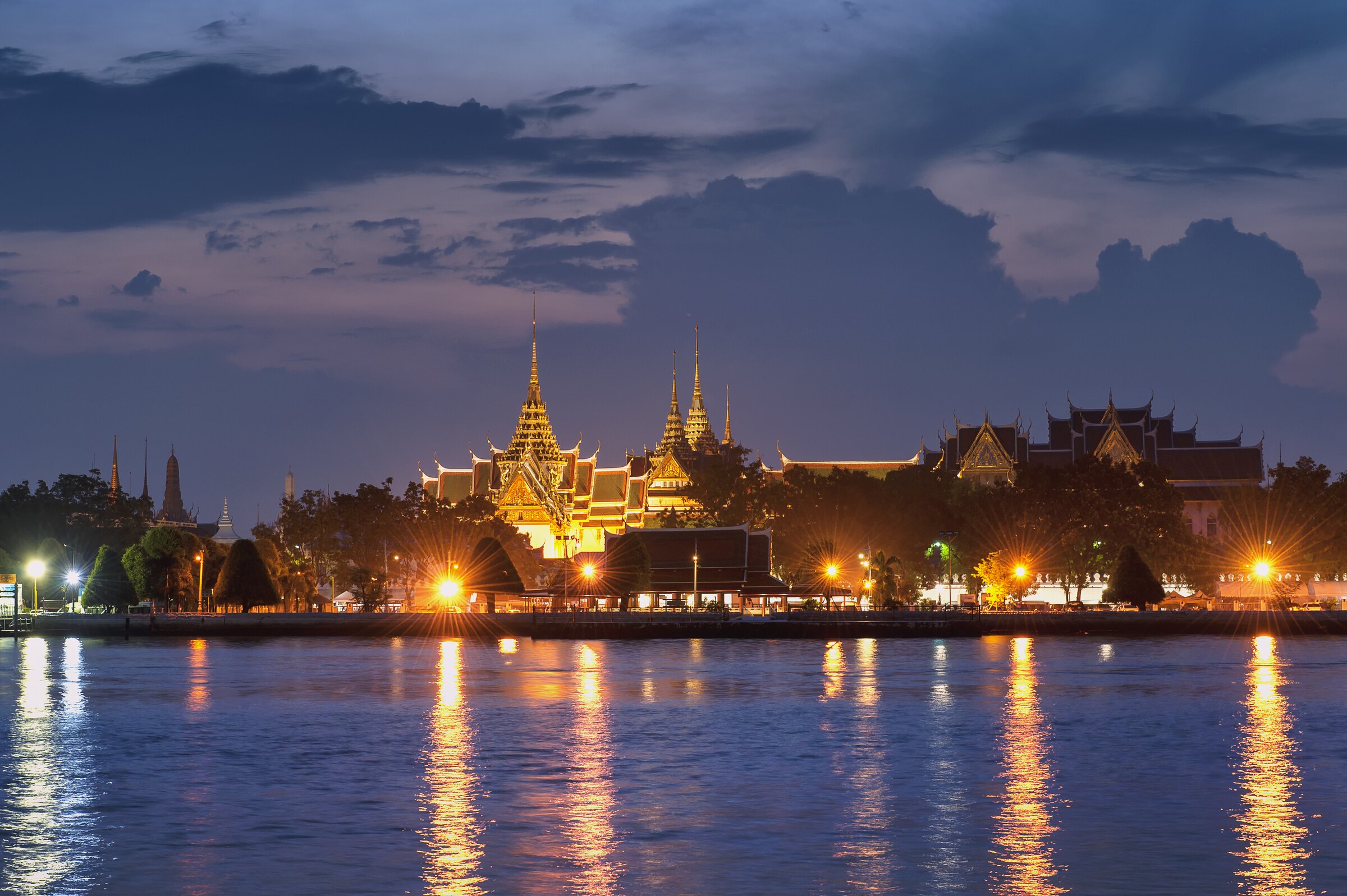
The Grand Palace & Wat Phra Kaew
The Temple of the Emerald Buddha
Bangkok’s founding monument and the home of the Emerald Buddha: formally beautiful, genuinely oppressive by mid-morning, and best taken at opening.
Where
Bangkok
The palace was begun in 1782, by the same decision that made Bangkok a capital. Rama I moved the court across the river from Thonburi and built a walled city within a city — throne halls, a private residence, a treasury, and at one corner a royal chapel with no monks living in it, built to house a single image.
That image is the Emerald Buddha, which is not emerald but a dark green jade, is smaller than almost everyone expects at well under a metre, and sits high above the heads of everyone in the hall. Its robes are changed three times a year, for the hot, rainy and cool seasons, by the King.
The complex is still in use for state ceremony, which is why the dress code is enforced without discussion and why parts of it close at short notice. It is also, by the middle of the morning, the most crowded place in Thailand.
Reading the Ramakien as one continuous story
The wall running round the temple courtyard carries the Ramakien, the Thai telling of the Ramayana, painted as a continuous band of panels. Most visitors see three of them, out of order, over someone’s shoulder. Read from the beginning and clockwise it is a coherent narrative: Phra Ram exiled, Nang Sida carried off by Thotsakan the demon king of Longka, Hanuman the white monkey general raising an army, a siege, a war. The panels were laid down in the first reign and have been repainted many times since, so what you are looking at is a nineteenth- and twentieth-century surface over an eighteenth-century composition. A guide who knows the sequence turns a wall into a morning.
Why it is worth being at the gate first
The complex opens in the morning and is comfortable for perhaps ninety minutes. After that the coach groups arrive in a body, the courtyard between the chapel and the golden chedi fills, and moving through the cloister becomes a matter of shuffling. Heat compounds it: the courtyards are stone and marble with almost no shade, and the reflected glare by eleven is punishing. We take the whole thing at opening and are back on the river before the worst of it. If you can only come later in the day, we would rather build the morning around Wat Pho and the river and treat the palace as a shorter, more selective walk.
The hall that wears a Thai hat
The Chakri Maha Prasat, the largest building in the outer court, was designed in the 1870s by a British architect in an Italianate manner, then finished with a three-spired Thai roof after the court objected to a European dome. Bangkok has described it ever since as a foreigner wearing a Thai hat. It is a useful thing to stand in front of, because it states plainly what the reign was doing: taking European form and keeping Siamese authority over it, at exactly the moment every neighbouring kingdom was being colonised. Thailand was not, and this building is part of the argument for how.
How We Visit
Our way in
We are at the gate for opening, with a licensed guide who is a historian first — someone who can take the Ramakien cloister in sequence rather than pointing at three panels. Tickets are held in advance so nobody queues in the sun. We brief on the dress code before you pack, not at the entrance, where the queue for hired sarongs is an ordeal of its own. Ninety minutes inside is usually right. We then walk to Wat Pho, ten minutes away and immediately calmer, and take the boat from there.
Questions
What travellers ask
Can you visit the Grand Palace privately?
You can visit privately in the sense that matters: your own guide, your own car, your own pace, with tickets held in advance. The palace is a public site in daily use for state ceremony and is not closed for individual visitors, and any company promising exclusive after-hours access to Wat Phra Kaew is not being straight with you. What a private visit buys is timing and expertise, which is most of the difference.
What is the dress code for the Grand Palace?
Shoulders and knees must be covered, for men and women alike. That rules out vests, shorts, short skirts, ripped jeans and anything see-through; ordinary sandals are fine. The rule is enforced at the entrance rather than politely suggested, and the sarong-hire counter carries a long queue in the heat. We tell clients exactly what to wear before they leave the hotel.
How long do you need at the Grand Palace?
Ninety minutes to two hours covers the temple courtyard and the outer palace halls, which is about as long as the heat and the crowds make pleasant. Arriving at opening is the difference between a considered walk and a shuffle. Most people pair it with Wat Pho, ten minutes away on foot, and finish on the river — half a morning in total.
Journeys That Include This
Ask about The Grand Palace & Wat Phra Kaew
It sits inside a journey we already run, and it fits just as easily into one written from scratch around your dates.
Nearby