Wat Pho
The Temple of the Reclining Buddha
Forty-six metres of reclining Buddha, cloisters of images rescued from Ayutthaya, and the school where Thai massage has been taught for two centuries.
Where
Bangkok
Best time
The first hour after opening, before the Grand Palace crowd walks across.
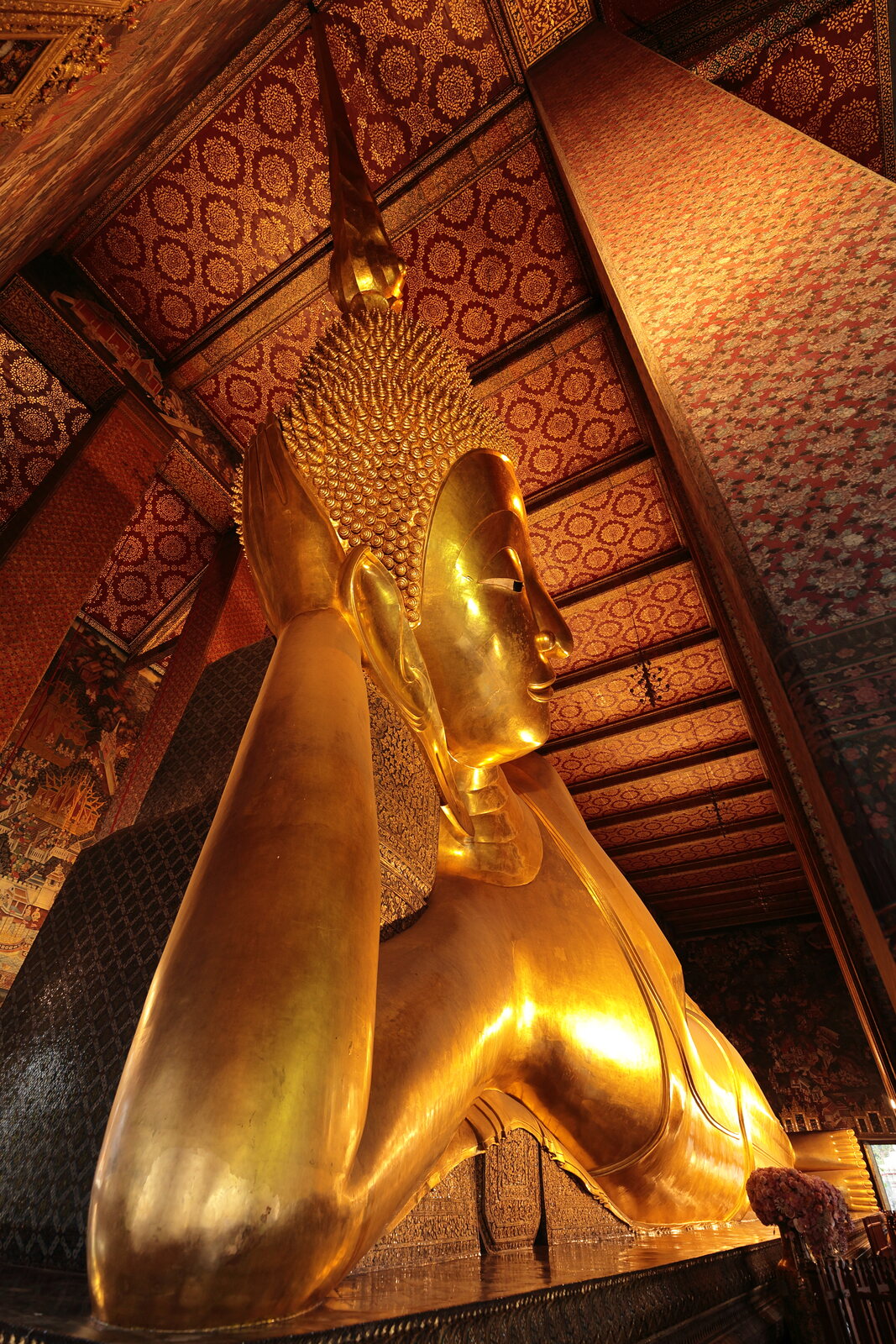
The reclining Buddha is forty-six metres long and fifteen high, which means you never see all of it at once. You come in at the feet, walk the length of it down a narrow aisle, and the head is a separate encounter at the far end. The core is brick and plaster, the surface gold leaf, and the soles of the feet are mother-of-pearl, inlaid with the hundred and eight auspicious marks by which a Buddha is recognised.
The hall was built around the figure, and the building is why the effect works: there is no vantage point from which the whole can be taken in, only a sequence of parts.
Wat Pho is older than Bangkok. It was already here when Rama I enlarged it, and by the third reign it had become something close to a public university, its walls and pavilions carrying inscriptions on medicine, massage, astrology and literature for anyone literate enough to read them.
The hundred and eight bowls, and what the coins are for
Along the wall behind the reclining figure stand a hundred and eight bronze bowls, one for each of the marks on the soles opposite. Visitors buy a small bowl of satang coins at the head of the aisle and drop one into each as they walk, which is an act of merit and also the reason the hall has a continuous metallic rain running through it. It takes a few minutes to do properly, and children take to it immediately. The coins go towards the upkeep of the temple. It is the rare piece of temple ritual that a visitor is openly invited to join rather than watch from the side.
The oldest school of Thai massage, still teaching
Wat Pho is where Thai traditional medicine was codified and where it is still taught. Reliefs and inscriptions set into the walls and pavilions record the body’s energy lines and the treatment of particular complaints, much of it gathered here in the nineteenth century after the loss of Ayutthaya’s libraries; the epigraphic archive is on UNESCO’s Memory of the World register. The temple’s school still trains practitioners inside these walls and treats visitors on site. It is not the oiled, scented thing sold along the beach roads — a proper Thai massage is firm, methodical, and closer to being stretched than being soothed.
The quiet parts almost everyone walks past
Most visitors come in, see the Buddha and leave, which keeps the rest of the compound remarkably calm. Four great chedis in glazed tile stand in a courtyard that few people cross into, each raised for a king of the dynasty. The cloisters hold close to four hundred gilded Buddha images seated shoulder to shoulder, many brought down from Ayutthaya and Sukhothai after their own temples were abandoned. And scattered through the grounds are stone figures of Chinese officials and warriors, ballast again from the junks, now standing guard over Thai courtyards with entirely the wrong expression.
How We Visit
Our way in
We come in the first hour after opening, before the Grand Palace crowd finishes and walks across. That gives you the reclining hall with room to stand back, the four chedis to yourselves, and the cloisters still cool. Our guide reads the inscriptions and the feet — the hundred and eight marks are a text, not a decoration — and we then arrange a session with a senior practitioner at the temple’s own school rather than one of the shops outside the wall. The same dress code applies as at the palace.
Questions
What travellers ask
Is Wat Pho worth visiting if you have already seen the Grand Palace?
Yes, and for many people it is the better hour of the two. Wat Pho is ten minutes’ walk from the palace, admits far fewer people, and gives you the forty-six-metre reclining Buddha, four royal chedis and cloisters of gilded images rescued from Ayutthaya. It is also the home of Thai traditional massage, so it is the one temple where you can sensibly stay for a treatment afterwards.
How long does it take to see Wat Pho?
An hour covers the reclining Buddha and the main courtyards comfortably, and ninety minutes lets you take in the four royal chedis and the cloisters without hurrying. Add another hour if you want a massage at the temple’s school, which is worth booking rather than joining the walk-in queue. Most visitors are through in twenty minutes and miss most of what is there.
Can you get a massage at Wat Pho?
Yes. The temple’s traditional medicine school operates on site, treating visitors as well as training practitioners, in the courtyard where Thai massage was codified. Expect firm, methodical pressure and a good deal of assisted stretching rather than oils and aromatherapy. Wear loose clothing. Walk-in waits can be long in the middle of the day, so we book a slot with a senior therapist in advance.
Journeys That Include This
Ask about Wat Pho
It sits inside a journey we already run, and it fits just as easily into one written from scratch around your dates.
Nearby