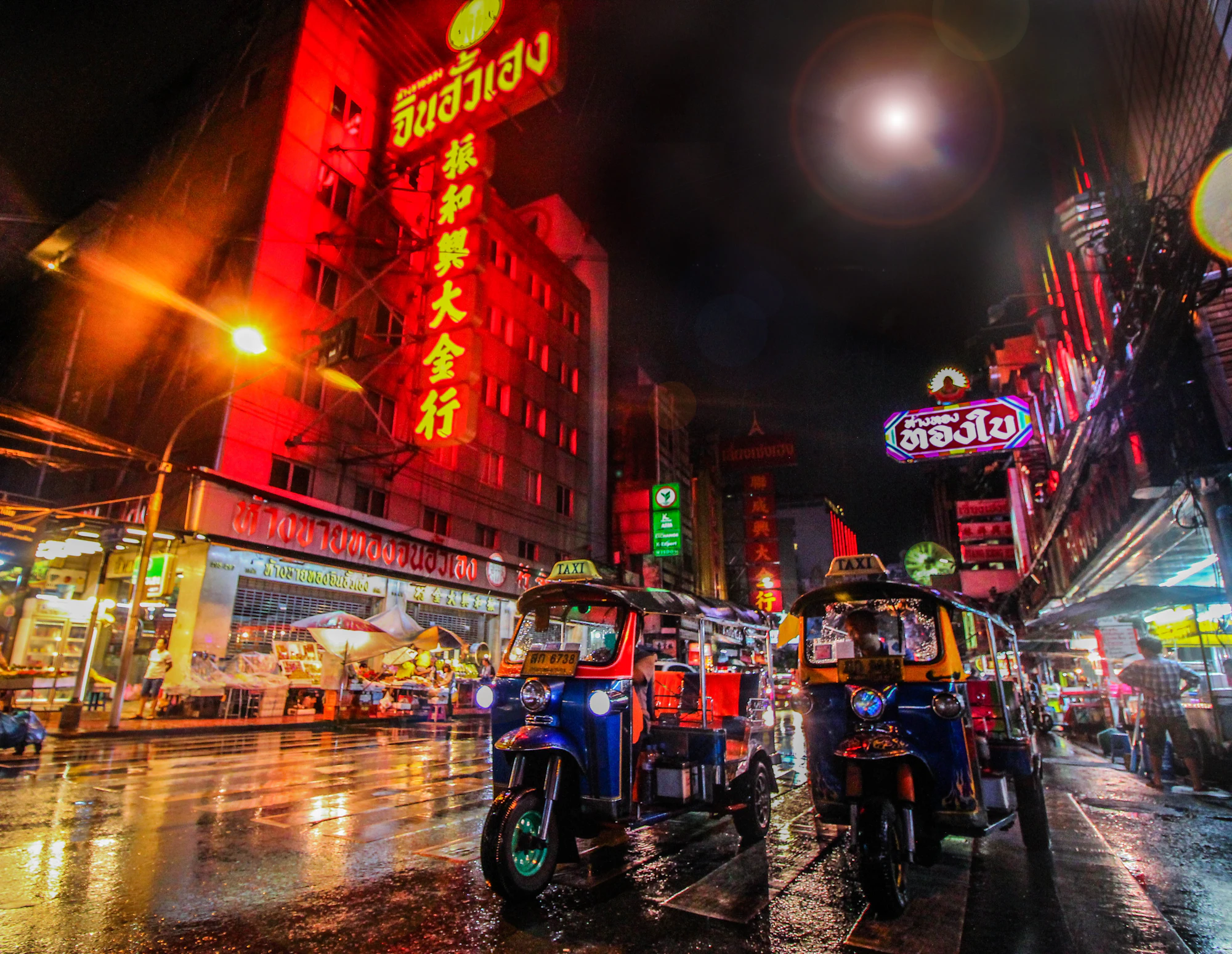
Talat Noi
A riverside grid of engine workshops, Hokkien shrines and a Portuguese church, wedged between Chinatown and the river, best walked without a route.
Where
Bangkok
Best time
November to February for walking weather, and early — the lanes belong to the workshops before the heat arrives.
Talat Noi means little market, and there has not been much of one for a long time. What there is instead is a few hundred metres of lanes between Yaowarat and the river, packed with second-hand engine workshops — marine diesels, gearboxes, blocks stacked to head height on the pavement, men working with the doors up and the radio on.
The lanes are narrow enough that you meet them shoulder first, and they run in no pattern you can hold in your head. Getting mildly lost is the correct way to see it.
Between the workshops sit the things that record who lived here: a Hokkien shrine several centuries old with incense coils hung from the ceiling, a Portuguese-founded Catholic church on the riverbank, a courtyard mansion built by a Chinese trading family with a swimming pool sunk into the middle of it, and, on a good many walls, a decade of murals painted by people who came for the same reason you did.
So Heng Tai, the mansion with a pool in the courtyard
The So Heng Tai mansion is a two-hundred-year-old Hokkien courtyard house — timber, four wings around an open square, one of very few of its kind still standing in Bangkok — and in the middle of the courtyard the family has installed a deep swimming pool used by a diving school. The combination sounds like vandalism and is, in practice, what has kept the building up: the descendants refused to sell the land, and the school pays for the roof. There is a coffee counter under the eaves. Sitting there with the timber galleries above you is one of the better twenty minutes in the old city.
The shrine, the church, and what they record
Chow Sue Kong shrine, tucked between two workshops, is among the oldest Chinese shrines in the city: Hokkien, dark, thick with smoke, hung with red coils that burn for days. A short walk away, on the riverbank, stands Holy Rosary Church, founded by Portuguese-descended Catholics granted this ground in the eighteenth century and rebuilt in the Gothic manner in the nineteenth, with a carved Christ carried through the lanes at Easter. Neither is a monument; both are in weekly use. This quarter has always been where people who arrived by boat were given land, and it has kept the receipts.
Photographs, and the limits of them
Talat Noi has become a place people photograph, and there is a version of the walk that consists entirely of standing in front of murals and a well-known vintage car left rusting in a lane. It is a thin version. The quarter is far more interesting as a working district than as a backdrop: a man rebuilding a gearbox will talk about it if you ask, the shrine keeper will explain the coils, and the coffee is better on the corner nobody has posted about. We ask clients to put the phone away for the first twenty minutes, and it changes what they notice for the rest.
How We Visit
Our way in
We walk Talat Noi on foot and slowly, usually straight after the river or before dinner in Yaowarat, with a guide who knows the households rather than the photo spots. Nothing here needs a ticket, so what we are actually arranging is introductions — the shrine keeper, the mansion’s family, a workshop where you can watch a diesel come apart. It is a quarter we have filmed, and the people in that film are the people you will meet. Comfortable shoes and a tolerance for narrow lanes are the only requirements.
Questions
What travellers ask
What is there to see in Talat Noi, Bangkok?
A dense grid of riverside lanes holding second-hand engine workshops, the two-hundred-year-old So Heng Tai courtyard mansion with a diving pool at its centre, the Hokkien Chow Sue Kong shrine, the Portuguese-founded Holy Rosary Church and a decade of street murals. There is no single monument here. The interest lies in the density, and in the fact that all of it is still in daily use.
How do you get from Yaowarat to Talat Noi?
On foot, in ten to fifteen minutes. Talat Noi sits immediately south-east of Yaowarat, between Chinatown and the Chao Phraya, and the two are usually walked as one route: the quarter in late afternoon, Yaowarat once the street kitchens open. The Chao Phraya express boat and the MRT at Hua Lamphong both leave you within a short walk of the lanes.
Is Talat Noi worth visiting?
Yes, if you want Bangkok without a queue. It rewards an unhurried hour on foot rather than a checklist, and it is one of the few central quarters where working life, three religions and two centuries of migration sit within a few hundred metres. If you are short of time and want temples and gilding, it is not the place. If you have already seen those, it is the antidote.
Journeys That Include This
Ask about Talat Noi
It sits inside a journey we already run, and it fits just as easily into one written from scratch around your dates.
Nearby