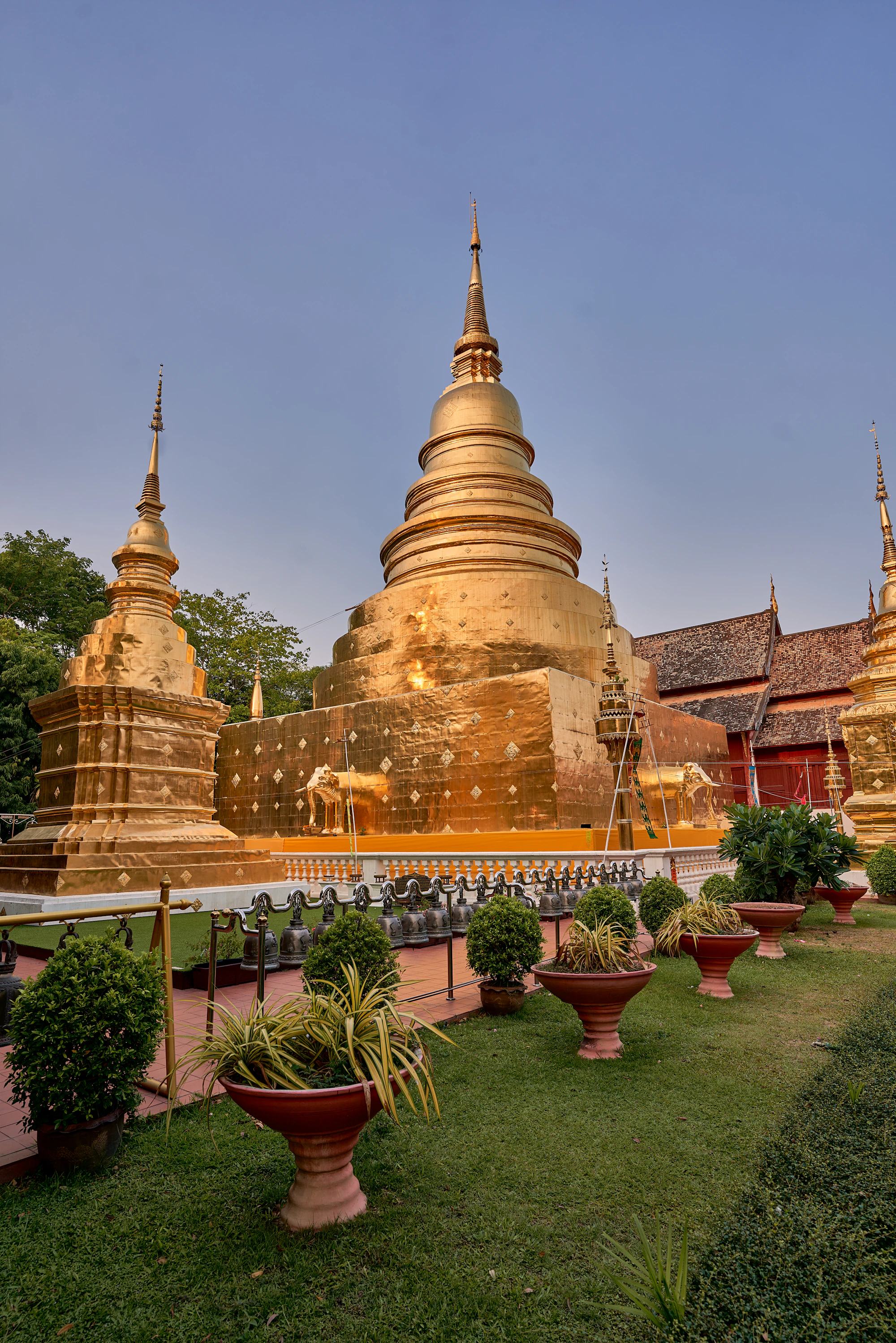
Wat Phra Singh
The most complete Lanna temple inside Chiang Mai's old city, and the one whose murals reward standing still for half an hour.
Where
Chiang Mai
Best time
November to February, in the cool season. Songkran in April if you want to see the Phra Singh image carried through the city.
Wat Phra Singh sits at the western end of Ratchadamnoen, inside the moat, and has done since the fourteenth century. It is the temple Chiang Mai uses: a monastic school, a working ordination hall, a courtyard that fills with people at festival and empties again by evening. The gilded viharn on the main axis is the one everyone photographs, and it is not the reason to come.
The reason is the small building behind it. The Viharn Lai Kham is Lanna woodwork at its best — a low, dark, teak-framed hall with a gilded stucco facade, a coffered ceiling and an interior scaled to a person rather than to a state. Its walls carry the finest surviving nineteenth-century murals in the north.
It is a five-minute walk from three other temples of the first rank, which is why we always take the old city on foot.
The murals in the Viharn Lai Kham
The two side walls carry folk narratives painted in registers, and the painters clearly enjoyed themselves. Between the episodes of the stories they filled in the north as they knew it: market scenes, courtship, drinking, a foreign trader with a hat and a beard, men with tattooed thighs, women at looms, a quarrel in a doorway. The register is domestic and often comic.
Crucially they are painted low. Most Thai temple murals put their action above head height; these begin near the floor, so you read them as you would a book at arm's length. Give it half an hour and a torchless eye that has adjusted to the dark, and it becomes the most informative single room about pre-modern northern life anywhere in Chiang Mai.
The Phra Singh image and the water festival
The temple takes its name from the Phra Buddha Sihing image it houses, whose origins are contested between Thailand, Sri Lanka and several rival claimants — there are other images with the same name and the same claim elsewhere in the Kingdom. The argument is old and unsettled, and the temple does not pretend otherwise.
At Songkran the image is carried out and processed through the streets so that people can pour scented water over it, which is the point at which the whole quarter becomes impassable and wonderful. If your dates fall in mid-April, we plan around it deliberately rather than apologising for it. Outside the festival the image sits in the Lai Kham, behind the murals, in near silence.
Walking the moat quarter
Wat Phra Singh only makes full sense alongside its neighbours. Wat Chedi Luang, ten minutes east, holds the vast truncated brick chedi that once housed the Emerald Buddha before an earthquake took its upper stages. Wat Phan Tao beside it is an entire viharn built from salvaged teak panels of a former royal residence, and is dark, small and the quietest of the three.
Taken together in one slow morning on foot they give you the whole arc of Lanna building: the state monument, the domestic hall, the royal timber. Taken separately by car, with a car park each, they become a list. The old city is walkable; we walk it.
How We Visit
Our way in
We take the old city on foot, early, starting before the heat and before the school groups. Your guide is a Lanna art historian rather than a tour leader, which matters here more than anywhere else in Chiang Mai: the Lai Kham murals need somebody who can point at a corner of a wall and tell you what the painter was doing. We time the Lai Kham for when the light is coming through the door rather than when the queue is. Modest dress applies. If you would like it, we finish with breakfast at a place inside the moat and no schedule after that.
Questions
What travellers ask
What is Wat Phra Singh famous for?
For being the most complete Lanna temple in Chiang Mai and for the Viharn Lai Kham, a small teak hall whose nineteenth-century murals of everyday northern life are the finest in the region. It also houses the revered Phra Buddha Sihing image, which is carried in procession through the city during Songkran each April. It sits inside the old city walls at the western end of Ratchadamnoen.
Is there a dress code at Wat Phra Singh?
Yes. Shoulders and knees must be covered for men and women, shoes come off before entering any of the halls, and hats come off in the shrines. It is a functioning monastery with a monastic school, so quiet matters as much as clothing. Sarongs can be borrowed at the entrance if needed, but arriving already covered is simpler and better manners.
How long do you need at Wat Phra Singh?
An hour does it justice, of which half should be spent inside the Viharn Lai Kham letting your eyes adjust to the murals. Rushing it in twenty minutes leaves you with a photograph of a gilded facade and nothing else. Because Wat Chedi Luang and Wat Phan Tao are a ten-minute walk away, we usually build a half-day on foot around all three.
Journeys That Include This
Ask about Wat Phra Singh
It sits inside a journey we already run, and it fits just as easily into one written from scratch around your dates.
Nearby