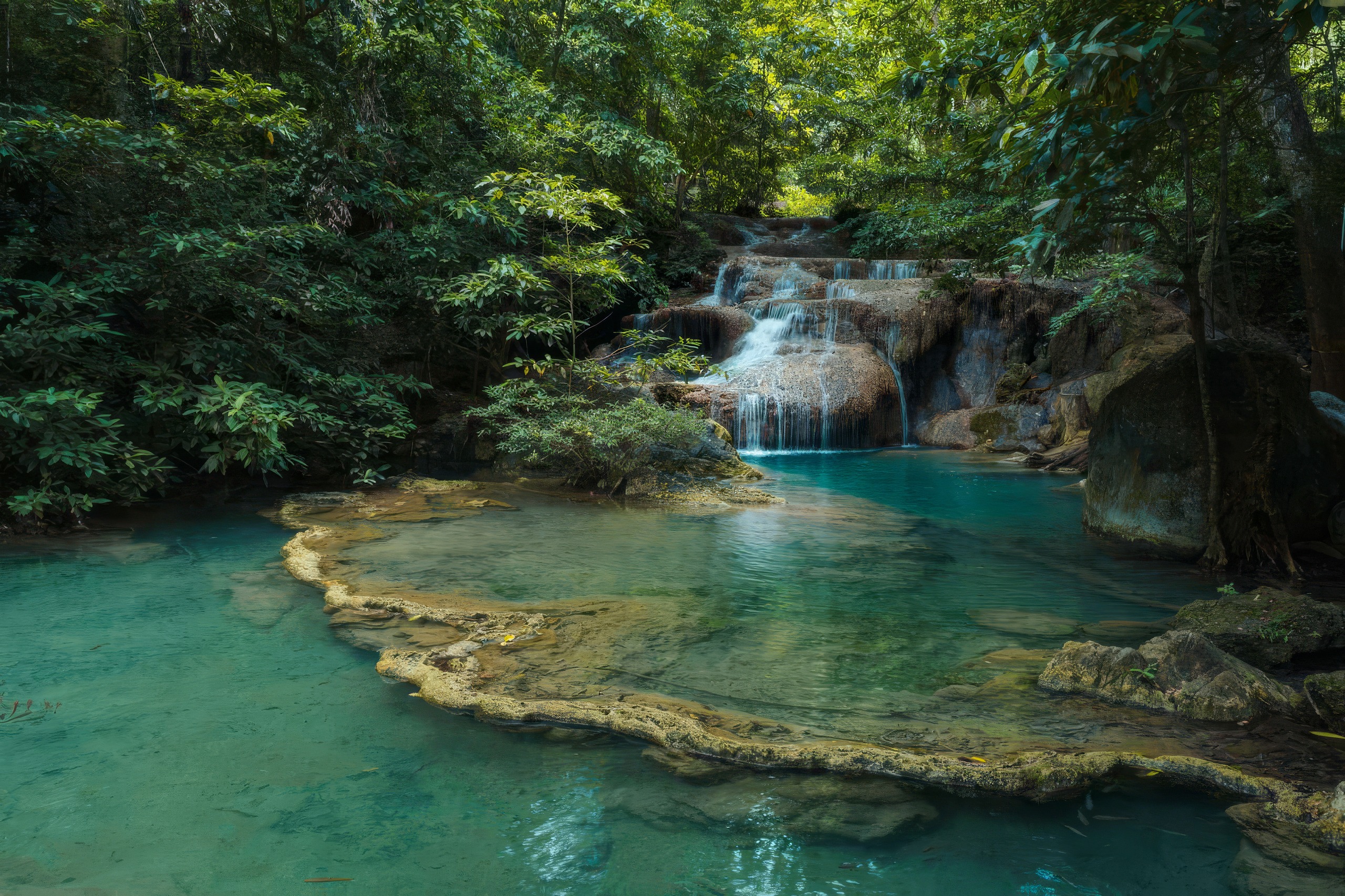
Erawan Falls
Seven tiers of turquoise limestone pools in the Kanchanaburi forest. Most visitors stop at the third, which is why the upper ones repay the climb.
Where
Kanchanaburi
Best time
The falls run hardest late in the green season, from September into November.
The water at Erawan runs over limestone, takes up dissolved calcium carbonate on the way, and lays it down again as it falls, building the lips of its own pools. That is why the colour is what it is, a dense blue-green that never photographs as it looks, and why the rims are smooth and rounded rather than cut into rock steps.
There are seven named tiers, spread over roughly a kilometre and a half of forest path with a good deal of height between them. The bottom three are wide, shallow, easily reached and full of people. From the fourth the path narrows and steepens; by the sixth and seventh you are on roots and wet rock with your hands involved.
The name comes from Erawan, the three-headed elephant of the myths. The top tier is said to resemble it, from the right angle, if you are willing.
What the climb actually involves
It is not a technical walk, but it is a real one in thirty-odd degrees with the humidity that comes off a river. Between the first tier and the seventh you gain a couple of hundred metres, most of it in the upper half, on a path that becomes a scramble over tree roots and wet limestone. Shoes matter more than anything else: the rock is slippery wherever the water runs, and sandals are how people turn an ankle. Two hours up and down at an unhurried pace is realistic if you swim on the way. The park stops admitting walkers to the upper tiers in the afternoon, so late starts get turned back below the fifth.
The fish, and the rules that keep it clean
The pools hold shoals of soro brook carp, which are protected, entirely unbothered by people, and inclined to investigate anything that stays still — including feet. It is a strange sensation the first time and completely harmless. Feeding them is not allowed. Nor is carrying a plastic bottle above the second tier without leaving a deposit you collect on the way down, a blunt scheme that has visibly worked: the upper forest is clean. Soap and shampoo in the pools are prohibited for the obvious reason. Swim where the signs allow, and stay off the travertine rims, which take a very long time to build and no time at all to break.
When there is water, and when there is not
Erawan is fed by the forest around it rather than by a large catchment, so its volume follows the rains closely. It runs hardest from September into November, at the end of the green season, when the pools are full and the upper tiers are properly loud. From March into May the flow can drop to very little and the lower pools become paddling. The colour holds better than the volume, and even low the water keeps that particular blue, but anyone whose picture of the place involves falling water should come in the second half of the year.
How We Visit
Our way in
We go in the morning, straight from Kanchanaburi and ahead of the domestic weekend crowd, so the lower tiers are still quiet and the climb is done before the worst of the heat. Water and proper footwear are our problem rather than yours. A guide walks with you as far as you want to go — most clients reach the fifth tier, some the seventh — and no pressure is applied in either direction. Where a family splits, one of us stays with the lower pools. Weekends and Thai public holidays are busy here, and we will say so.
Questions
What travellers ask
How many tiers does Erawan Falls have, and do you have to climb them all?
Seven, spread over about a kilometre and a half of forest path. You do not have to climb them all: most visitors stop at the second or third tier, which are the widest and the easiest to swim in. The fourth is where the crowd thins. The sixth and seventh involve scrambling over roots and wet rock and take real effort in the heat.
Can you swim at Erawan Falls?
Yes, in most of the seven tiers, and the pools are the main reason to come. The water is cool and clear and holds shoals of small protected fish that will nibble at your feet. Soap, shampoo and feeding the fish are all prohibited, and plastic bottles carried above the second tier require a refundable deposit. Bring shoes you are happy to walk in wet.
What is the best time of year to visit Erawan Falls?
September to November, at the end of the green season, when the falls are at their fullest. The pools hold their colour year-round, but between March and May the flow can drop considerably. Whatever the month, start early in the day: the park limits access to the upper tiers in the afternoon, and the climb is far more pleasant before the heat builds.
Journeys That Include This
Ask about Erawan Falls
It sits inside a journey we already run, and it fits just as easily into one written from scratch around your dates.
Nearby