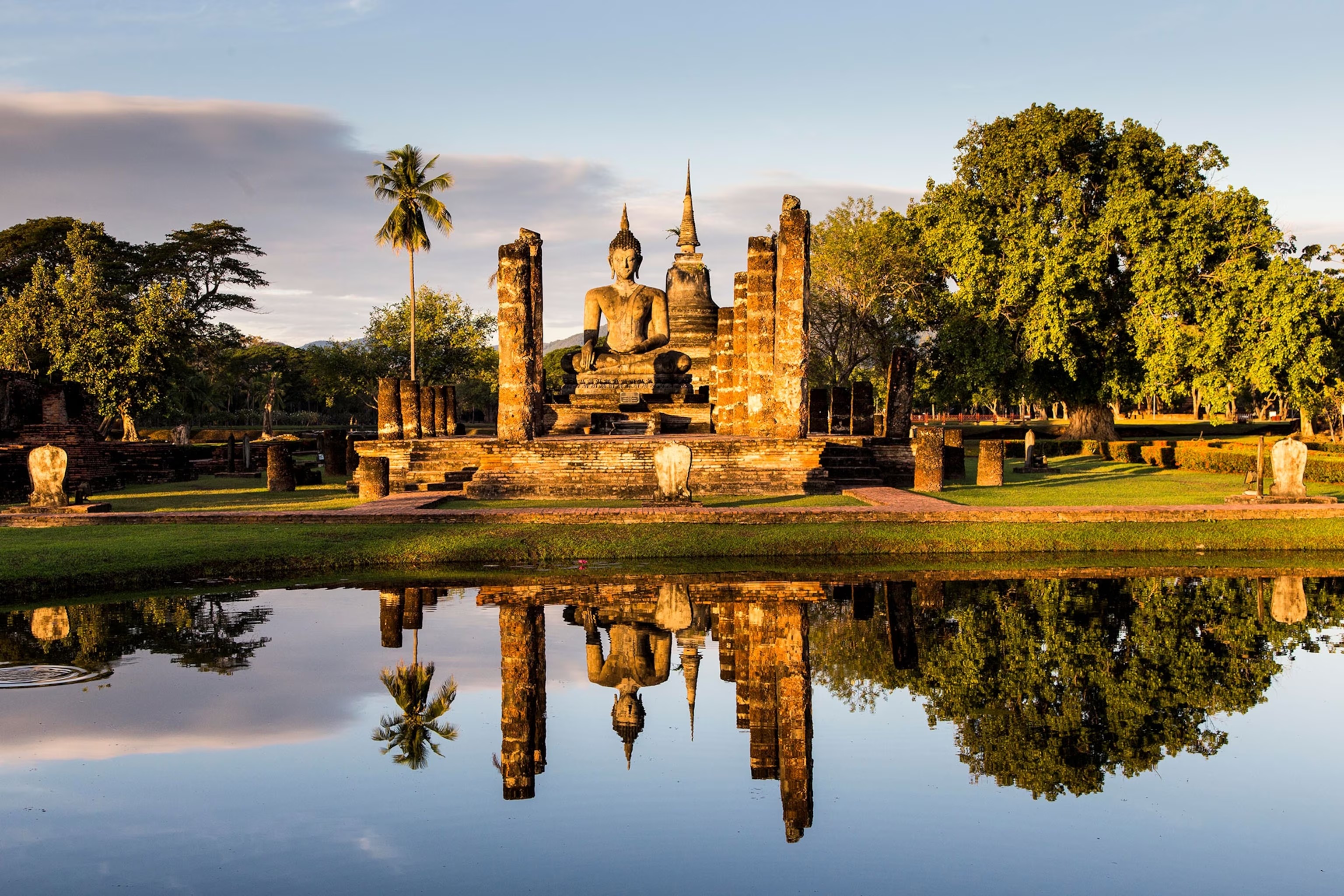
Sukhothai
Thailand’s first capital, and the quieter of the two ancient cities: lotus ponds, open lawns, and a walking Buddha made in this form nowhere else.
Where
Sukhothai
Listed
UNESCO World Heritage, inscribed 1991
Best time
Sunrise or the last hour of light, when the ponds mirror the chedis.
Sukhothai was the seat of the first substantial Thai kingdom, from the middle of the thirteenth century, and it is the more beautiful of the country’s two ruined capitals for a reason that has little to do with what survived. Ayutthaya is a ruin inside a living town, with traffic between the temples. Sukhothai is a park: mown lawns, ponds, frangipani, and long distances between buildings.
The art here is distinct. Sukhothai bronze casters made the walking Buddha, a figure caught mid-stride with one heel lifted and the free hand raised, modelled with a fluidity that reads as almost boneless. It was made nowhere before and nowhere since in quite this way, and it is the clearest single contribution Thai art has made to the history of sculpture.
The modern town sits twelve kilometres east of the ruins, which is much of what keeps the park quiet.
Seeing it from a bicycle
The central zone is walled, flat, shaded in places and about a kilometre and a half across, with more ground between it and the northern and western sites. It is laid out for movement: causeways between ponds, a road that loops the perimeter, and no hills anywhere. Cycling is not a novelty for visitors here but the sensible way to cover the distances, and it changes the register of the day — you arrive at Wat Sa Si across a causeway rather than out of a van. Bicycles are hired at the gate. For anyone who would rather not pedal in the heat, an electric cart and a driver cover the same ground, and we would still get you off it at every temple.
Wat Si Chum, and the Buddha in the slot
Wat Si Chum, in the northern zone, is a square brick mondop with no roof and a single narrow vertical slot in its front wall. Through it, at close range, you see a seated Buddha some fifteen metres high almost filling the interior — a hand the size of a person resting on a knee, the fingertips thick with gold leaf applied by hand. The confinement is the point: the building was raised to the image rather than around it, and the slot rations what you are given until you step through. A passage in the thickness of the wall, now usually closed, once led past engraved stone slabs telling the Jataka tales.
The inscription, and the argument about it
In 1833 the future King Mongkut found a stone pillar here carrying an inscription dated 1292, in the name of King Ramkhamhaeng, describing a kingdom where there was fish in the water and rice in the fields and any subject could ring a bell at the palace gate to petition the king. It has been treated ever since as the founding document of Thai script and Thai statecraft, and it sits on UNESCO’s Memory of the World register. A number of scholars have questioned whether it is really of the thirteenth century. The debate is unresolved, and it is a great deal more interesting standing here than it sounds on paper.
How We Visit
Our way in
Sukhothai is a night rather than a day trip: the drive from Bangkok is long, the flight schedule is thin, and the reward is being in the park at sunrise and again in the last hour, when the ponds go still and everyone else has gone to dinner. We arrange bicycles, or a cart and driver, and a guide who can hold the difference between Sukhothai and Ayutthaya form rather than reciting dates. For those who want more, Si Satchanalai an hour north is part of the same inscription and almost empty.
Questions
What travellers ask
How long do you need at Sukhothai?
A full day in the park and at least one night nearby. The central zone takes three to four hours at a civilised pace, and the northern and western zones add another two. The reason to stay over is being there at sunrise and in the last hour of light, when the ponds mirror the chedis. A day trip from Bangkok is not practical — it is more than four hundred kilometres north.
Is Sukhothai better than Ayutthaya?
They are different rather than ranked. Ayutthaya is grander, much closer to Bangkok and considerably busier, a ruined capital inside a working town. Sukhothai is older, quieter, more spacious and easier to love, with lawns and ponds between the temples and room to cycle. If you have one day, take Ayutthaya. If you have two nights and want calm, take Sukhothai.
Is Sukhothai a UNESCO World Heritage Site?
Yes, inscribed in 1991 as the Historic Town of Sukhothai and Associated Historic Towns, which covers Sukhothai itself together with Si Satchanalai and Kamphaeng Phet. The three were listed as one property because they represent the first distinctly Thai artistic and political flowering. Si Satchanalai, about an hour to the north, receives a small fraction of the visitors.
Journeys That Include This
Ask about Sukhothai
It sits inside a journey we already run, and it fits just as easily into one written from scratch around your dates.
Nearby