Ayutthaya
Capital of Siam for four centuries until it burned in 1767, and a UNESCO park of brick prangs and headless Buddhas at its best once the coaches leave.
Where
Ayutthaya
Listed
UNESCO World Heritage, inscribed 1991
Best time
Late afternoon, when the brick warms and the day-trip coaches have gone.
Ayutthaya was founded in 1351 on an island made by three rivers, and for four hundred years it was the capital of Siam and one of the largest cities on earth. Ships came up from the Gulf to trade. Portuguese, Dutch, French, Japanese and Persian communities lived in their own quarters outside the walls, and European envoys went home with drawings of gilded temples they compared to Paris and Venice.
In 1767 a Burmese army took the city after a siege of more than a year, burned it, and stripped the gold from the images. The court never came back. What stands now is brick without its plaster, chedis leaning where the ground has moved, and rows of seated Buddhas whose heads were taken — some in the sack, more by later looting.
It sits about eighty kilometres north of Bangkok, which is why it fills with day-trip coaches by ten in the morning and empties again by four.
The four temples worth giving the time to
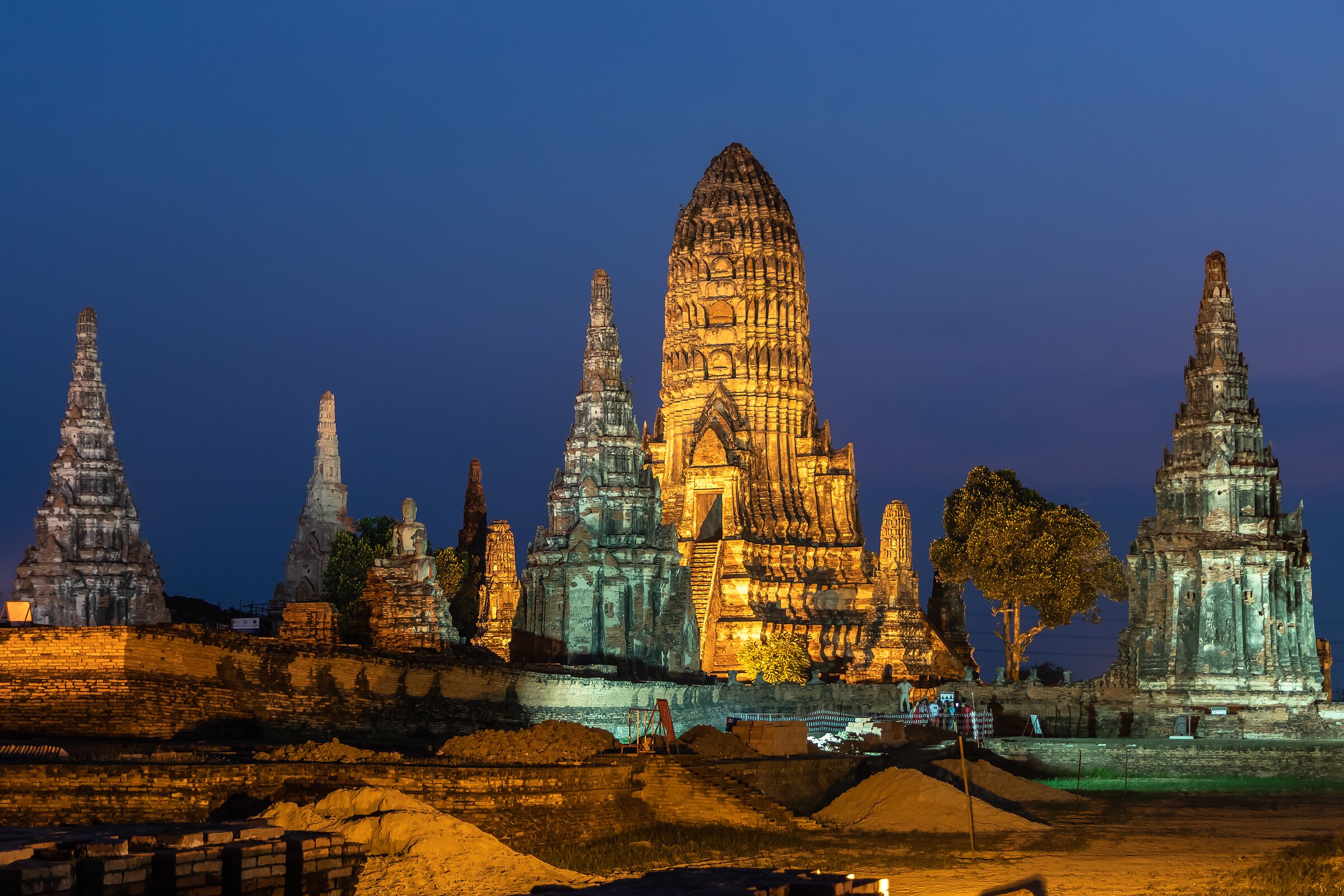
Wat Chaiwatthanaram, on the west bank of the river, is the one to build the visit around: a Khmer-form prang on a raised platform ringed by eight subsidiary towers, put up in 1630, and the only site here that reads as a complete composition rather than a fragment. Wat Phra Si Sanphet gives you three restored bell-shaped chedis in a line, raised over the ashes of three kings, inside what were the palace grounds. Wat Mahathat holds the sandstone Buddha head grown into the roots of a bodhi tree, which is genuinely arresting and thoroughly mobbed. Wat Ratchaburana has a crypt you can climb down into, where a royal treasure was recovered in the 1950s after looters had got there first.
The hour after four
The coaches run to a timetable and the timetable ends in the middle of the afternoon. From about four the park changes character: the light comes in low along the brick, which turns the colour only fired clay does, and the temperature drops to something you would choose to walk in. Cattle graze the grass between the ruins. Several of the principal temples are lit after dark, which makes Chaiwatthanaram in particular worth crossing the river for a second time. Anyone who has done this on a coach day trip has seen Ayutthaya in flat white noon light alongside three hundred other people, and it does the place no favours whatsoever.
Arriving the way the city was meant to be reached
Ayutthaya stands on the Chao Phraya, and for four centuries the river was how you got here. A private boat between the old capital and Bangkok takes several hours but gives you the approach the place was designed for: rice country, temple landings, and barge trains of sand and cement being towed south four and five at a time. We generally drive up early, while the road is clear, and come back down on the water in the evening with dinner aboard. Doing it the other way round means arriving at the ruins in the worst light of the day and leaving before the best.
How We Visit
Our way in
We go up by road early, before the northern expressway thickens, with a guide who works in period rather than anecdote — someone who can explain why a Khmer-form prang and a Sinhalese-form chedi stand two hundred metres apart. Lunch and the hottest hours are spent out of the sun. We stay for the late light, and where clients want it we dine on a private boat coming back down the river. Nothing is compressed to fit a second destination into the same day, which is the usual failing here.
Questions
What travellers ask
What is the best time of day to visit Ayutthaya?
Late afternoon into dusk. The day-trip coaches from Bangkok arrive mid-morning and are largely gone by four, after which the light comes in low across the brick and the heat becomes bearable. Several of the main temples are illuminated after dark. Early morning is the second-best window; the middle of the day is hot, crowded and photographically flat.
How far is Ayutthaya from Bangkok?
About eighty kilometres north, which is one to two hours by road depending on how badly Bangkok is behaving. It works comfortably as a day trip, and can also be reached by train or by private boat along the Chao Phraya. The river route takes several hours and is best done in one direction only, usually returning south in the evening.
Is Ayutthaya a UNESCO World Heritage Site?
Yes. The Historic City of Ayutthaya was inscribed on the UNESCO World Heritage List in 1991, for what survives of the Siamese capital destroyed by the Burmese in 1767. The listed area covers the historic island and its principal temple complexes, which are conserved as an archaeological park rather than rebuilt, so most of what you see is ruin stabilised in place.
Journeys That Include This
Ask about Ayutthaya
It sits inside a journey we already run, and it fits just as easily into one written from scratch around your dates.
Nearby