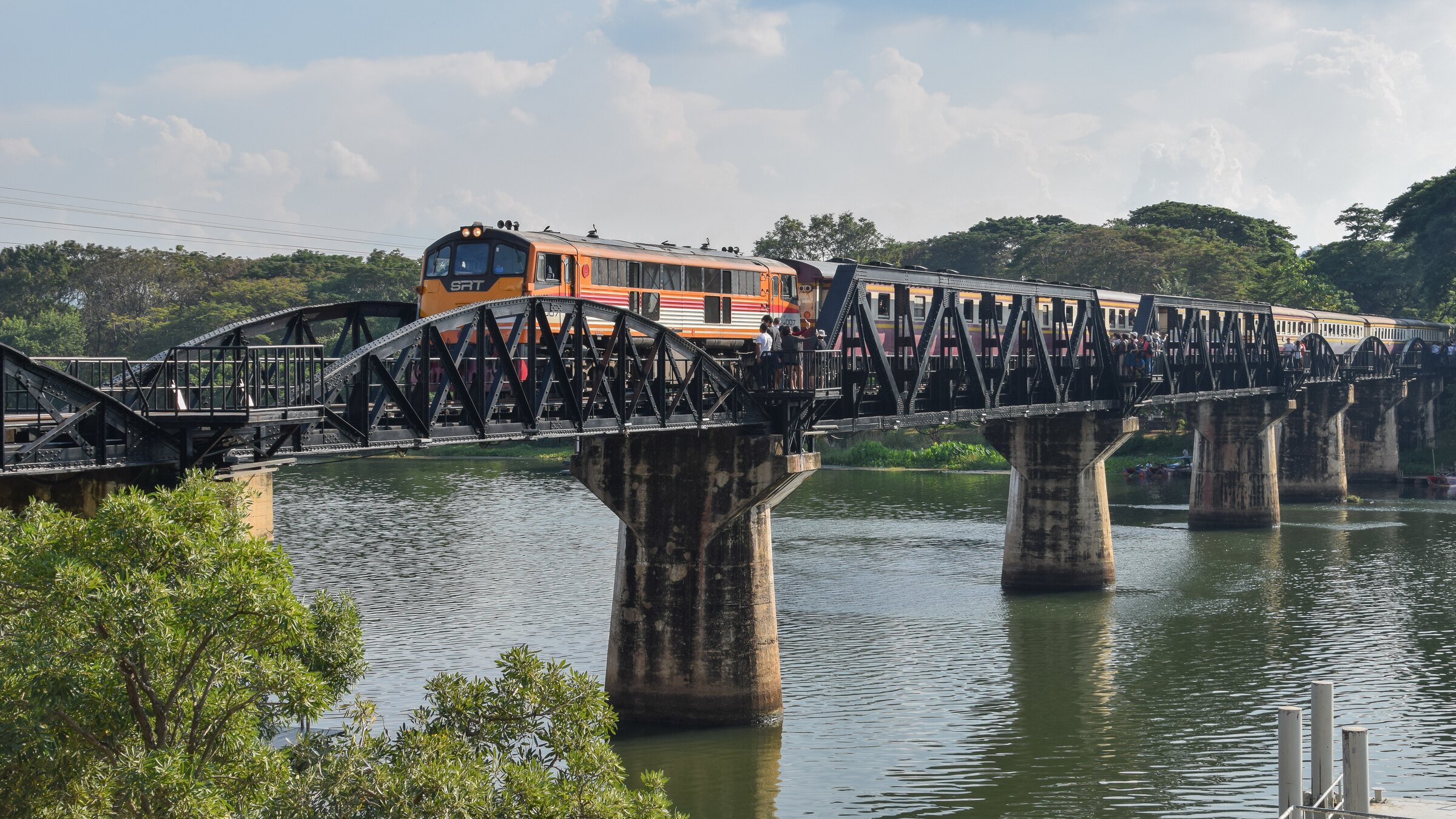
Kanchanaburi & the River Kwai
The bridge draws the crowds; the rock cutting at Hellfire Pass and the war cemeteries are why the day deserves to be given properly.
Where
Kanchanaburi
Best time
November to February for the cool, dry weather; late green season if the waterfalls are the point.
Between 1942 and 1943 the Japanese army drove a railway from Thailand into Burma — four hundred and fifteen kilometres of it, through country British surveyors had judged impractical a generation earlier. It was finished in about sixteen months by Allied prisoners of war and by a far larger number of conscripted Asian labourers. Something in the order of twelve thousand prisoners died, and the estimates for the labourers run several times higher.
The bridge at Kanchanaburi is the fragment everyone knows, largely because of a novel and a film that took liberties with both the engineering and the men. It is a real bridge on the real line, and trains still cross it. The river beneath it was called the Mae Klong until the 1960s, when it was renamed Khwae Yai so that the place would match the story.
The town has grown up around it. The rest of the railway has not, and that is where the day should be spent.
Hellfire Pass
Konyu Cutting, eighty kilometres up the line from the town, is where the railway had to be driven through solid rock. Men worked it by hand, with hammer and tap and baskets, for eighteen hours a day through the 1943 monsoon, lit at night by carbide lamps and fires — which is where the name came from. The cutting is still there: a corridor of rock with the drill marks visible in the walls and the sleepers long gone. An interpretive centre above it, maintained by the Australian government, holds veterans’ testimony, and a walking trail follows the old track bed down through the cutting and along the embankments beyond. It is quiet, and it is the part of the day people remember.
The cemeteries, and how to read them
Kanchanaburi War Cemetery sits in the middle of town behind a low wall, and Chungkai lies a few kilometres out along the river. Both are Commonwealth War Graves Commission ground: level lawns, uniform bronze plaques, and ages that are almost all under thirty. Read the inscriptions and the shape of the railway emerges from them, men of the same regiment dying within days of one another as cholera moved through a camp. The Thailand–Burma Railway Centre opposite the town cemetery gives you the structure to make sense of that before you walk in, and it is a better hour than the museums beside the bridge.
The train, and whether to take it
The line still runs from Kanchanaburi up to Nam Tok on its original alignment, over a wooden trestle viaduct clinging to a rock face above the river at Wang Pho. It is a slow, hot, entirely ordinary Thai train with the windows open, and it takes about two hours. As sightseeing it is unremarkable; as a way of registering what the ground was like and what was asked of the men who laid the track, twenty minutes on the viaduct section does more than any exhibit. We usually put clients on one leg only and drive the other, which stops the day becoming an endurance of its own.
How We Visit
Our way in
We give Kanchanaburi a full day rather than folding it into a circuit, and we go with a guide who handles it as history — someone who will tell you about the Asian labourers as well as the prisoners, and who will not narrate a cemetery. The order matters: the railway centre first for structure, then the cemetery, then up the line to Hellfire Pass in the afternoon once the light is off the rock. Families with a personal connection should tell us in advance, so grave references can be looked up and flowers arranged.
Questions
What travellers ask
Is the Bridge over the River Kwai worth visiting?
The bridge itself takes fifteen minutes and is ringed by souvenir stalls. What justifies the journey is the rest of the railway: Hellfire Pass and its interpretive centre eighty kilometres up the line, the Commonwealth war cemeteries at Kanchanaburi and Chungkai, and the Thailand–Burma Railway Centre in town. Treat the bridge as the introduction rather than the destination and the day repays itself several times over.
How far is Kanchanaburi from Bangkok?
About a hundred and thirty kilometres west, or two to three hours by road depending on when you leave the city. It is possible as a long day trip, but Hellfire Pass is a further eighty kilometres up the line, so anyone who wants to see the railway rather than only the bridge is much better served by staying a night on the river.
Can you visit Hellfire Pass?
Yes. The Hellfire Pass Memorial lies about eighty kilometres north-west of Kanchanaburi at Konyu Cutting, and comprises an interpretive centre maintained by the Australian government and a walking trail down through the cutting along the old track bed. There is no admission charge. The descent and the return climb are steep and hot, so morning or late afternoon is far better than the middle of the day.
Journeys That Include This
Ask about Kanchanaburi & the River Kwai
It sits inside a journey we already run, and it fits just as easily into one written from scratch around your dates.
Nearby