Hua Hin
The royal family has summered here since the 1920s and the town kept the composure: a flat beach, a carved railway pavilion, and a market worth eating in.
Where
Hua Hin
Best time
November to March. September and October are the wet months on this stretch of the upper Gulf.
Hua Hin became a resort because of the railway. The line south reached it in the early 1910s, Bangkok society followed, and by the late 1920s the King had a summer palace on the shore north of the town — Klai Kangwon, which translates as far from worries and was named without irony.
What the town kept from that period is a certain restraint. There are no cliffs and no dramatic water. There is a long, flat, brown-gold beach that runs for kilometres, a fishing pier, a station with a royal waiting pavilion in carved and painted teak, and a hotel from the 1920s with a garden of clipped topiary. The sea is the Gulf: warm, calm, and not the transparent green of the Andaman, which is worth knowing before you arrive.
It is two and a half to three hours from Bangkok by road, and the only coast you can reach from the capital without flying.
The station, the pavilion and the old railway hotel
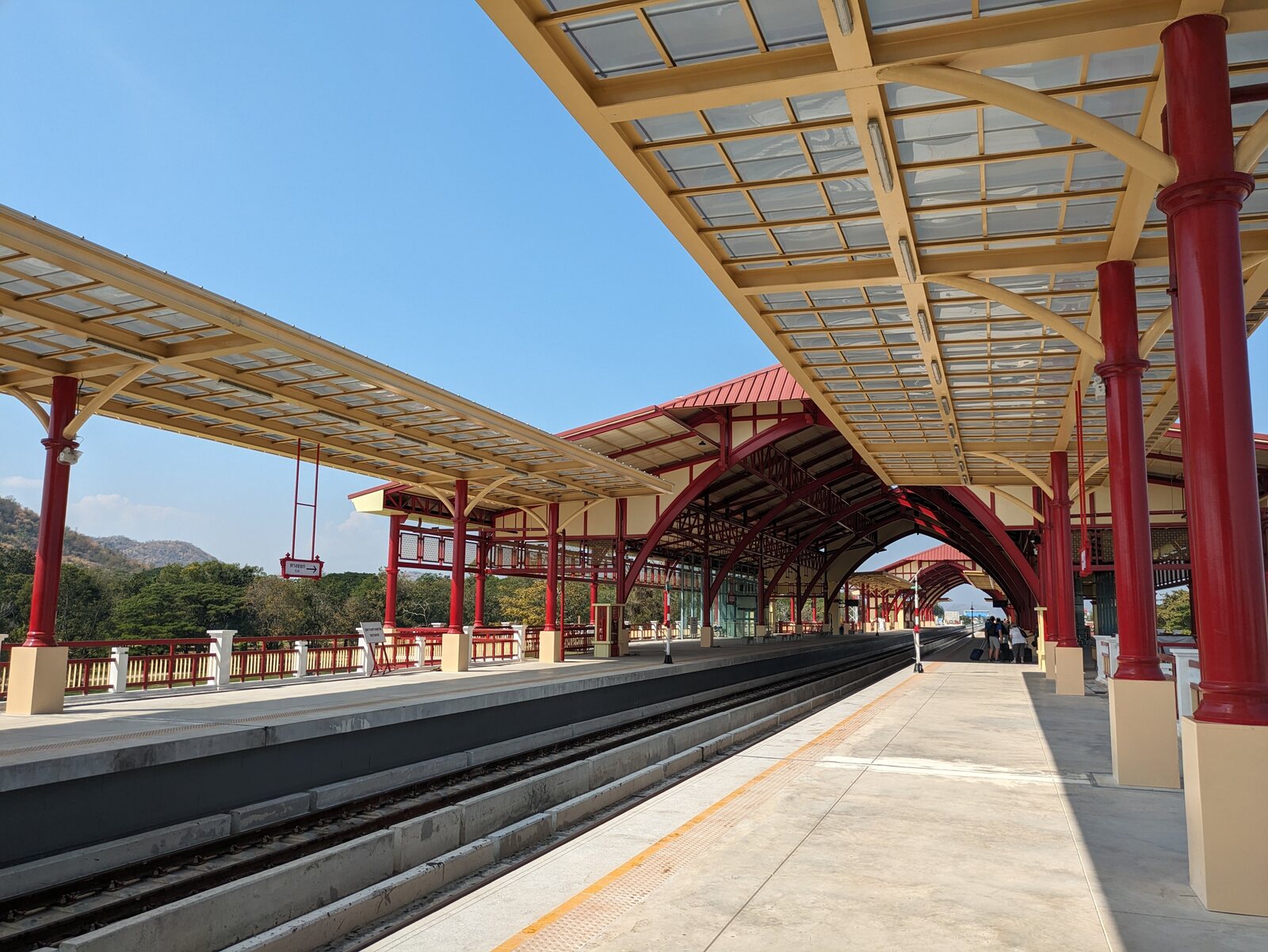
Hua Hin’s railway station is the most photographed piece of architecture on this coast, and the reason is the pavilion beside it: a red and gold royal waiting room in carved teak, built in the reign of Rama VI and moved here from a palace inland when it was no longer needed there. Trains still stop. Ten minutes away stands the resort hotel opened in the 1920s by the State Railway, to give its passengers somewhere worth arriving at — long verandas, a topiary garden of elephants and birds, and afternoon tea taken with a degree of ceremony. Between them the two buildings explain the town in half an hour: it exists because the line came.
South, to the limestone and the cave
Much of the interest on this coast is south of the town rather than in it. Khao Sam Roi Yot, the mountain of three hundred peaks, is a small national park of limestone towers rising straight out of marsh and shrimp ponds, with a coastal cave, Phraya Nakhon, reached by boat and then a short but genuinely steep climb. Inside, under a collapsed roof open to the sky, stands a gilded royal pavilion built in the 1890s. For an hour or so in the morning a shaft of sun comes through the hole and lands on it. The photograph everyone has seen is of that moment, and it is one of the few that undersells the thing itself.
Where the seafood actually is
Hua Hin’s night market is the rare one that has not degraded into a souvenir arcade: it still turns over enough seafood to a local trade to keep the standards honest, and crab and prawns are bought by weight from the ice and grilled while you sit. Better still is the fishing village at Khao Takiab, or the quieter quays south of town, where the boats land in the afternoon and the restaurants behind the jetty cook what came off them. Away from the water, the town has a long-established Thai weekend crowd, which is the most reliable guarantee of a decent kitchen there is.
How We Visit
Our way in
We treat Hua Hin as two or three unhurried days rather than an overnight: a private transfer down from Bangkok or the airport, a morning at Khao Sam Roi Yot early enough for the light in Phraya Nakhon cave, and the rest given to the beach and the table. Where clients want the station, the palace grounds and the 1920s architecture, we send a guide who can place them in the reign they belong to. We book the restaurants that do not take walk-ins, and we will tell you honestly which of the famous ones are no longer worth the trip.
Questions
What travellers ask
Is Hua Hin worth visiting?
Yes, if you want a calm, well-run coast within driving distance of Bangkok rather than island scenery. The beach is long and flat, the sea warm and calm but not clear, and the town has kept a certain restraint from its royal-resort years. It suits families, golfers, and anyone adding two or three days of rest to a Bangkok itinerary. For turquoise water, fly south instead.
How do you get from Bangkok to Hua Hin?
By road in two and a half to three hours, which is how nearly everyone does it; a private car is simplest and allows stops on the way down. There is also a train along the original southern line, slower and considerably more atmospheric, and a small airport. No flight is necessary, which is the main argument for this coast over the islands.
What is the best time of year to visit Hua Hin?
November to March, when the Gulf coast is dry, the sea is calm and the mornings are cool. April and May are very hot. Rain falls mainly between May and October and is heaviest in September and October, but it tends to arrive as afternoon storms rather than all-day weather, so the shoulder months still work if you plan around the middle of the day.
Journeys That Include This
Ask about Hua Hin
It sits inside a journey we already run, and it fits just as easily into one written from scratch around your dates.
Nearby