Ban Chiang
A UNESCO World Heritage site in Udon Thani whose Bronze Age settlement and red-spiral pottery forced South-East Asian prehistory to be rewritten.
Where
Udon Thani
Listed
UNESCO World Heritage, inscribed 1992
Ban Chiang is an ordinary village in Udon Thani with an extraordinary floor. Beneath its lanes lies one of the earliest settled farming and metal-working communities in South-East Asia, occupied over thousands of years, whose excavation in the 1960s and 1970s changed what the region was understood to be.
The discovery story is almost too neat: an American student walking a village track caught his foot, went down, and found himself looking at the rims of painted pots protruding from the path. What followed was decades of excavation, a great deal of argument about dating, and inscription as a UNESCO World Heritage site in 1992.
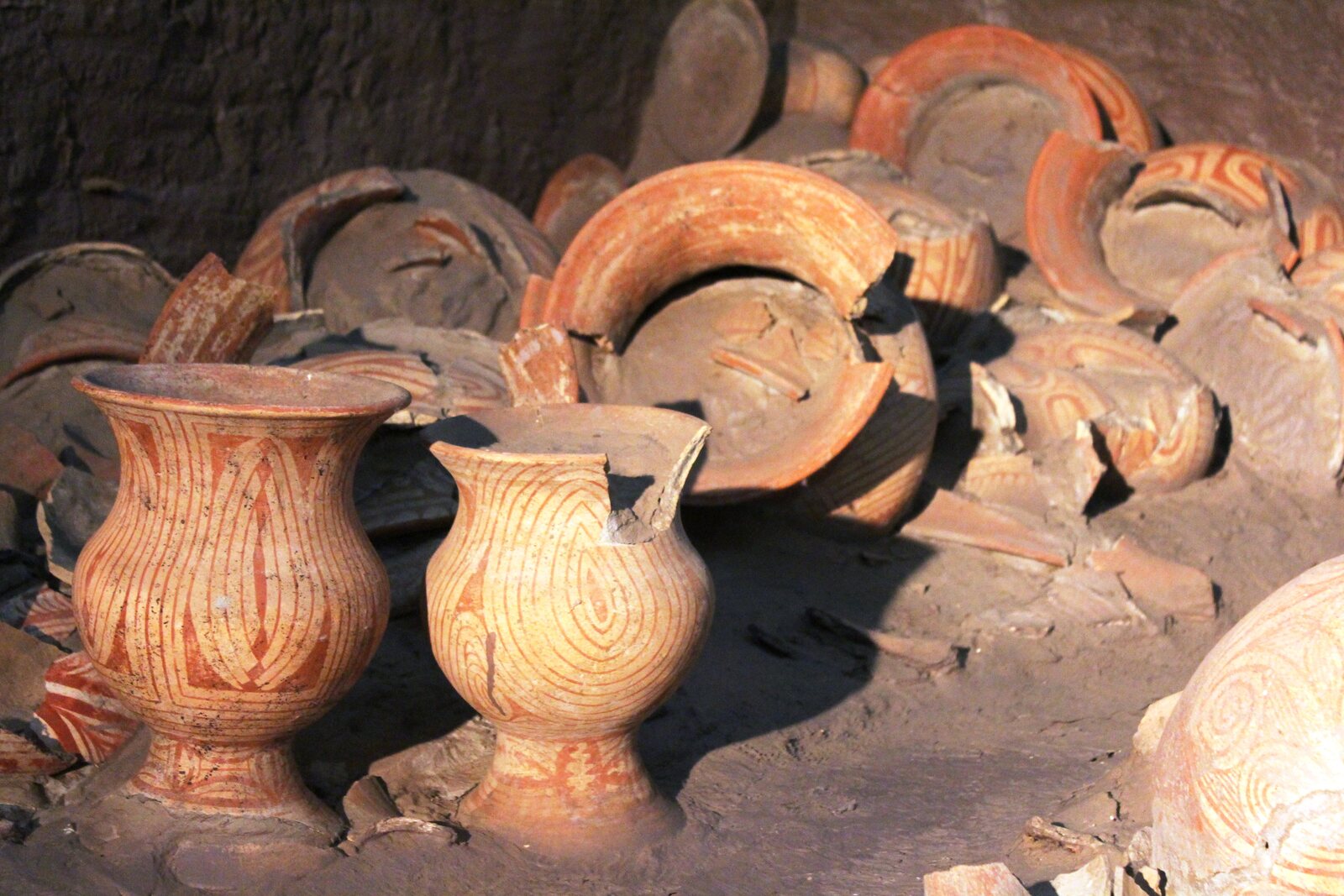
The pottery is the signature — buff-coloured vessels painted in red with running spirals and whorls, unmistakable and, unfortunately, much forged. The genuine material is here, in a museum that is small, unusually well made and almost always empty.
What Ban Chiang changed
Before Ban Chiang, the working assumption was that agriculture and bronze reached mainland South-East Asia relatively late, arriving from China or India, and that the region was culturally peripheral. The excavations produced evidence of settled rice farming, a long ceramic sequence and locally worked bronze on a timescale that made that assumption untenable.
The precise dating has been contested ever since, sometimes fiercely, with revised chronologies pulling the earliest phases later than the first published claims. What is not in dispute is that the argument had to be had at all, and that South-East Asian prehistory has been written differently since. Standing over the burials, that intellectual history is more interesting than any single object in the case.
The red spirals
The painted ware belongs to the later phases of occupation: buff or cream vessels carrying red curvilinear designs — spirals, whorls, running scrolls — applied freehand with a confidence that is obvious even at this distance in time. Many were made for the dead and placed in graves, sometimes broken deliberately, sometimes stacked around the body.
They are now the visual shorthand for Thai prehistory, reproduced on everything from hotel lobbies to banknotes, and they are extensively faked for the market. The museum holds excavated material with provenance, which is the only way to see the real thing. It also holds the bronze and iron work, glass beads and the roller stamps that are easy to walk past and worth ten minutes.
The open pit at Wat Pho Si Nai
A short distance from the main museum, within the grounds of Wat Pho Si Nai, an excavation trench has been left open and roofed. Burials lie where they were found: skeletons in the soil, pots stacked at the head and feet, the layers of the sequence visible in the cut face of the trench.
It is a far more affecting room than a gallery of cases, because it shows you the evidence as evidence rather than as objects. You can see how the site was read — which pot lay above which burial, and therefore which came first. Fifteen quiet minutes there does more for understanding the place than an hour of labels, and there is rarely anybody else in it.
How We Visit
Our way in
We treat Ban Chiang as a half-day of real substance rather than a stop on the way to somewhere, usually from Udon Thani, roughly an hour away by private car. Your guide is briefed on the archaeology and on the dating controversy, so that you get the argument rather than a recital of case labels. We take the museum first and the open burial pit at Wat Pho Si Nai second, which is the order that makes both land. Because it is quiet almost every day, timing is about heat rather than crowds, and mornings are better.
Questions
What travellers ask
Why is Ban Chiang a UNESCO World Heritage site?
Ban Chiang was inscribed as a UNESCO World Heritage site in 1992 as the most important prehistoric settlement so far discovered in South-East Asia. Its excavation revealed a long sequence of settled rice farming, burial practice and locally worked bronze that overturned the assumption that agriculture and metallurgy arrived late in the region from elsewhere, and reshaped how South-East Asian prehistory is written.
What is Ban Chiang pottery?
It is the painted earthenware from the site's later phases: buff or cream vessels decorated in red with freehand spirals, whorls and running scrolls, much of it made as grave goods and found placed with burials. It has become the visual signature of Thai prehistory and is very widely forged, so excavated pieces with provenance in the site museum are the only reliable way to see it.
Is Ban Chiang worth visiting?
Yes, if prehistory or archaeology interests you at all. It is a modest site rather than a monumental one, and its power is intellectual: this is where the story of early South-East Asia was rewritten. The national museum is small and unusually well made, the open burial excavation at Wat Pho Si Nai nearby is genuinely affecting, and it is almost always empty. Allow half a day from Udon Thani.
Journeys That Include This
Ask about Ban Chiang
It sits inside a journey we already run, and it fits just as easily into one written from scratch around your dates.
Nearby