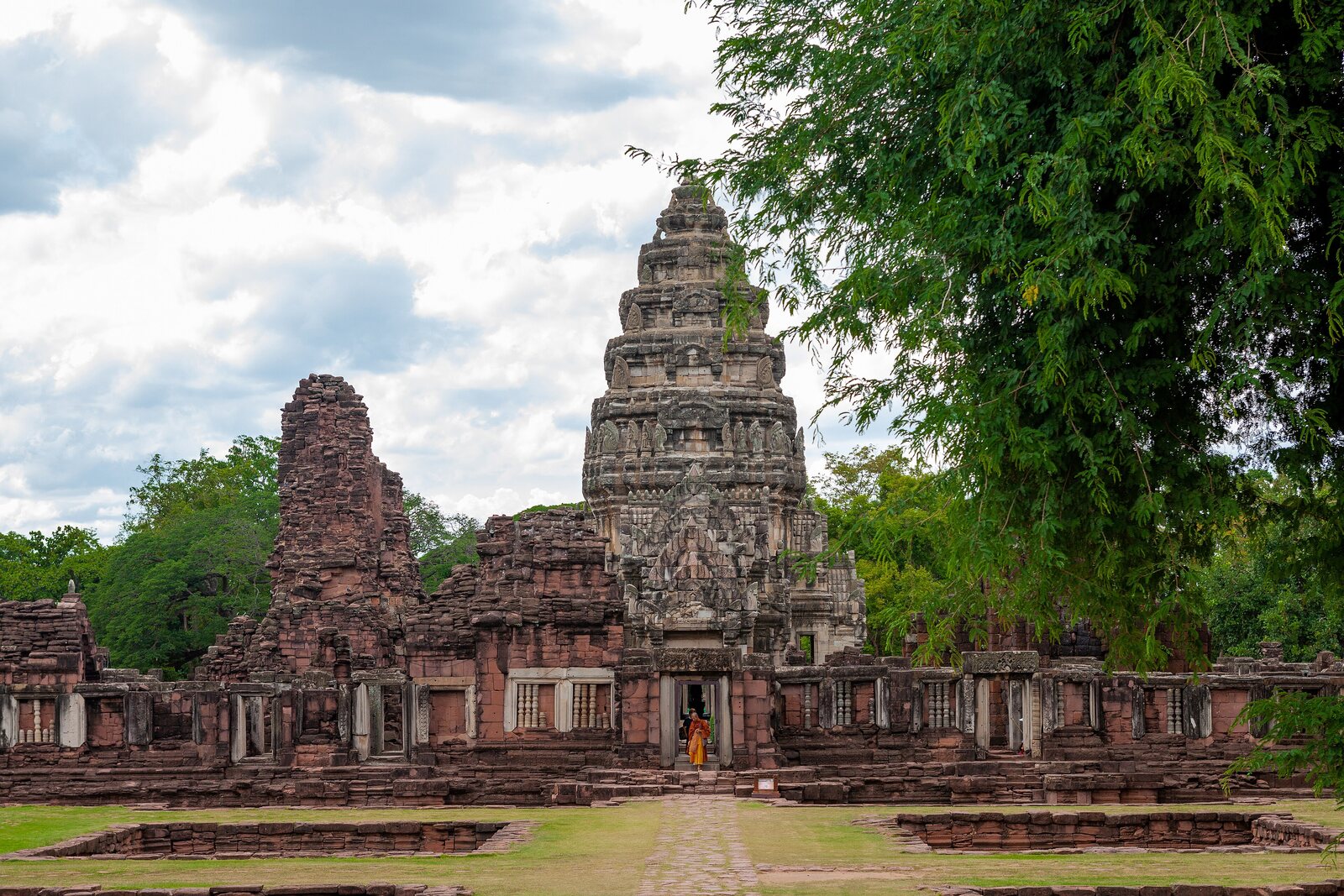
Phimai Historical Park
The largest Khmer complex in Thailand, built before Angkor Wat and turned to face it, standing in the middle of a working market town.
Where
Nakhon Ratchasima
Best time
November to February for the cool mornings, or the Phimai Festival in November for the boat races and the lit prasat.
Phimai is the temple that came first. Its main sanctuary was raised before Angkor Wat, and the plan it worked out — the cruciform tower, the antechambers, the galleried enclosure, the axial approach — is recognisably the plan that Angkor would later build at greater scale. Standing in the courtyard, you are looking at a rehearsal for the most famous building in South-East Asia.
It is also, unusually, oriented to the south-east rather than the east, and the accepted reading is that it was turned deliberately to face Angkor, at the far end of the ancient royal road that once connected the two. Nothing about a Khmer temple is accidental, least of all where its front door points.
And it sits in the centre of a small Isan market town, so you walk out of the eleventh century and into somebody's noodle shop.
Built before Angkor, and pointing at it
The road that once ran from Angkor north-west to Phimai was a real piece of imperial infrastructure, with rest houses and hospitals along it, and Phimai stood at its far end as the principal centre of the empire's northern reach. The orientation of the sanctuary toward the south-east is the clearest surviving statement of that relationship.
What you can see on the ground is the outer gate, the naga-lined causeway, the galleried enclosure and the white sandstone prang at the centre, restored across decades of careful work. The white stone is worth noticing in itself: most Khmer sanctuaries of this rank were built in the warmer pink and grey sandstones, and Phimai's pale central tower reads quite differently in early light.
A Buddhist temple in a Hindu empire
Phimai was dedicated as a Mahayana Buddhist sanctuary at a time when the Khmer state was overwhelmingly Hindu, and the carving reflects it. The lintels and pediments carry Buddhist scenes alongside the Hindu narratives you would expect, and the mixture is not a later overlay but original to the building.
That makes the site historically more interesting than its size alone would suggest. It sits at the point where Khmer religious allegiance was in motion, decades before Jayavarman VII made Buddhism the imperial creed. Read the lintels with someone who can tell you which story you are looking at, and the building becomes a document rather than a ruin.
The banyan and the museum
Two things outside the walls complete the visit. The Phimai National Museum, a short walk away, holds the lintels and sculpture lifted from the complex and from sites across lower Isan, including Khmer portrait sculpture of the kind that makes the empire feel populated rather than architectural. It is small, well arranged and almost never busy.
On the edge of town, Sai Ngam is a single banyan that has spread over generations into what looks like a grove — hundreds of trunks, all one organism, over an area you can walk through. It is a local picnic spot rather than a monument, and it is the right way to end a morning of stone.
How We Visit
Our way in
We take Phimai early, when the low sun is still raking across the lintels and the white sandstone has not yet gone flat. Your guide is a Khmer-period specialist who can read the carving rather than count the towers, and who can set the site against Angkor properly for anyone who has been. Because the complex sits inside a working town we walk it — sanctuary, museum, banyan, lunch in the market — rather than driving between car parks. It pairs naturally with Phanom Rung and Muang Tam over two unhurried days rather than one compressed one.
Questions
What travellers ask
Is Phimai older than Angkor Wat?
Yes. The main sanctuary at Phimai was built before Angkor Wat and prefigures its architectural plan, which is why it matters out of proportion to its fame. It is the largest Khmer complex in Thailand and was the principal centre at the northern end of the ancient royal road from Angkor, toward which its unusual south-easterly orientation is generally understood to point.
How do you get to Phimai?
Phimai lies about an hour north-east of Nakhon Ratchasima, often called Korat, which is roughly four hours by road from Bangkok and the natural gateway to lower Isan. The historical park sits in the centre of Phimai town, so the sanctuary, the national museum and the market are all within walking distance of one another. We drive it privately, usually en route to or from Phanom Rung.
Can you visit Phimai and Phanom Rung on the same trip?
Yes, and they belong together. They sit in neighbouring provinces along the same route through lower Isan, and seeing them in sequence shows you the Khmer world as a network rather than as isolated monuments. We would give them two days rather than one: Phimai and its museum on the first, Phanom Rung and Prasat Muang Tam at first light on the second.
Journeys That Include This
Ask about Phimai Historical Park
It sits inside a journey we already run, and it fits just as easily into one written from scratch around your dates.
Nearby