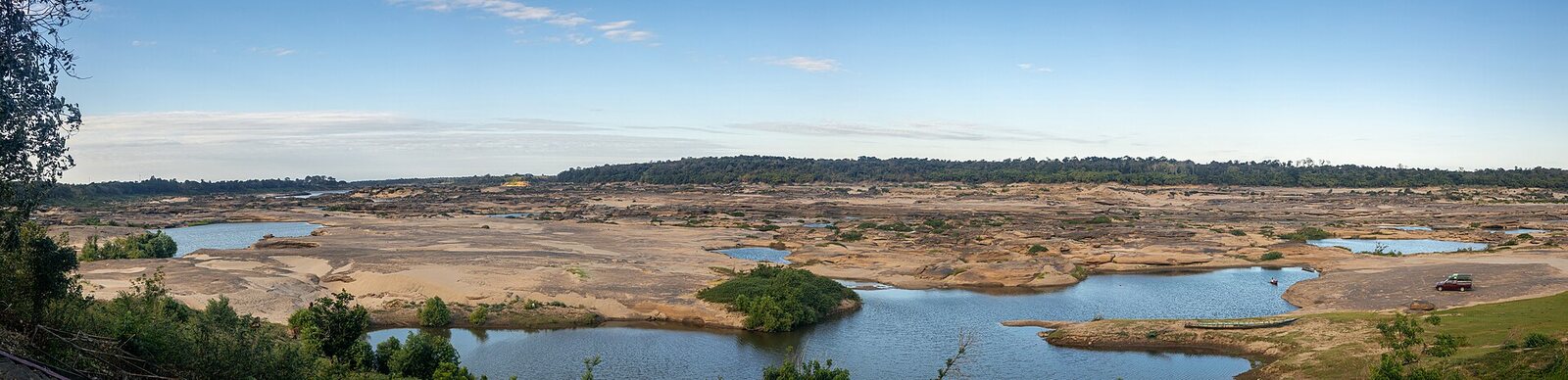
Sam Phan Bok
Thousands of hollows drilled into the Mekong bedrock, walkable only in the dry months and simply underwater for the rest of the year.
Where
Ubon Ratchathani
Best time
January to April, when the Mekong is at its lowest. Outside those months it is simply underwater.
Sam Phan Bok means, near enough, three thousand holes. When the Mekong drops in the dry season it uncovers a shelf of bedrock in Ubon Ratchathani riddled with them: rounded basins from the size of a bowl to the size of a room, some holding water and sky, some dry, running for a couple of kilometres along the river.
The comparison everybody reaches for is lunar, and for once it is not lazy. There is no vegetation, no shade and very little sound, and the scale is difficult to read because there is nothing in it of a known size. An hour of walking gets you across a landscape that will not exist in three months.
It is also, on most days, close to empty. This is the far east of Thailand, several hours from anywhere on a tour route, and that is precisely why we go.
How the river drills a hole
Each basin begins as a small depression holding a loose stone. In flood the current spins the stone, the stone grinds the rock, and the depression deepens into a cylinder; larger stones fall in, and over a very long time the cylinder becomes a bowl and neighbouring bowls merge. The process is the same one that carves potholes in any fast river, run at Mekong scale over a geological span.
What you are walking on, therefore, is a record of the river at full power, exposed only when the river is at its weakest. That inversion is the whole appeal of the place: you can stand in the middle of it precisely because, for a few months, the thing that made it has withdrawn.
A landscape with an annual expiry date
The rock is exposed roughly from January through April, when the Mekong is at its lowest, and it is still emerging at the start of that window and beginning to go under at the end. Outside those months it is not a poor visit; it is not a visit at all, because the site is beneath several metres of moving water.
Within the dry window the practical constraint is heat. The rock stores it, there is no shade whatsoever, and by mid-morning the surface is punishing. First light and the last hour of the day are the only sensible times to be out on it, which happens also to be when the low sun models the basins and the whole shelf reads as sculpture rather than as grey ground.
The rest of the Ubon river country
Sam Phan Bok is the headline, but the stretch of Mekong around it carries more. At Pha Taem, cliffs above the river hold prehistoric rock paintings — handprints, fish traps, elephants, human figures in ochre — running along a walkway at the top of a drop, facing into Laos.
At Khong Chiam the Mun river meets the Mekong and the two run visibly different colours for some distance below the junction, which gives the town its local name of the two-coloured river. Together with Sam Phan Bok these make a proper two-day river itinerary in a province almost nobody includes, and the emptiness is the point rather than a drawback.
How We Visit
Our way in
We only put Sam Phan Bok into a journey inside the dry window, and we say plainly when your dates fall outside it rather than substituting something and hoping. Access is by private vehicle from Ubon Ratchathani with a local driver who knows which track down to the rock shelf is passable that season, and we go at first light or late afternoon, never in the middle of the day. We carry water and shade. Where it suits the journey we run it with a longtail on the Mekong and the Pha Taem cliff paintings across two days rather than one.
Questions
What travellers ask
When can you visit Sam Phan Bok?
Roughly January to April, when the Mekong falls low enough to expose the bedrock. Outside those months the entire site is submerged and there is nothing to see. Within the window, go at first light or in the last hour of daylight: the rock shelf has no shade at all and becomes punishingly hot by mid-morning, and the low sun is what makes the basins read.
How do you get to Sam Phan Bok?
It lies on the Mekong in Ubon Ratchathani province, in the far east of Thailand near the Lao border, around two hours by road from Ubon Ratchathani city, which has direct flights from Bangkok. There is no practical public transport to the rock shelf itself, so a private car and local driver is the workable arrangement, and the final approach track varies with the season.
Is Sam Phan Bok worth the journey?
If you want an empty landscape rather than a monument, yes. It is a couple of kilometres of Mekong bedrock hollowed into thousands of basins, walkable for only a few months a year, and on most days you will meet almost no one. It sits far from any conventional route, which is exactly why it stays that way. It pairs well with the Pha Taem cliff paintings nearby.
Journeys That Include This
Ask about Sam Phan Bok
It sits inside a journey we already run, and it fits just as easily into one written from scratch around your dates.
Nearby