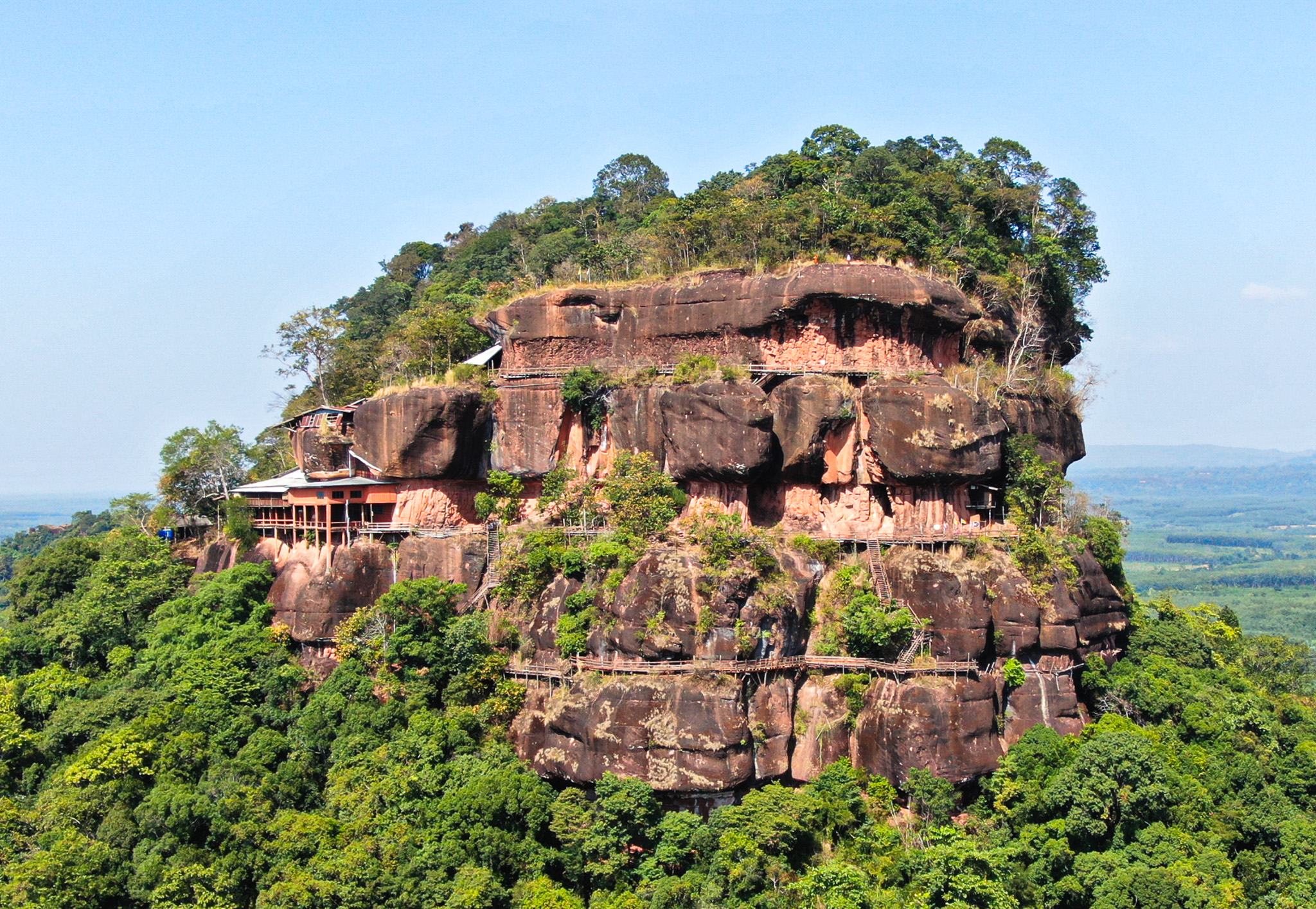
Wat Phu Tok
A meditation monastery on a sandstone tower near the Lao border, reached by wooden walkways pinned to the cliff. Not for anyone uneasy with heights.
Where
Bueng Kan
Wat Phu Tok rises out of flat farmland in Bueng Kan, close to the Mekong and the Lao border: a single isolated sandstone outcrop with sheer sides, entirely wooded on top. Around it, and in places directly across the face of the rock, runs a system of wooden stairs and walkways climbing through seven levels to the summit.
It was founded within the Thai forest tradition of the north-east, by a disciple of Ajahn Mun, as a place for monks to practise in isolation. The walkways were not built for visitors. They were built so that monks could reach caves and platforms in the cliff, and the exposure was understood as part of the practice rather than as an obstacle to it.
That remains the honest frame for a visit. This is a working monastery that happens to be spectacular, not a viewpoint that happens to have monks.
Seven levels, and what each one is for
The ascent is organised into seven stages, corresponding to the seven factors of awakening, and the character of the climb changes as you go. The lower levels are broad and shaded, with ordination and assembly buildings and a good deal of forest. The middle levels narrow into stairways cut against the rock. The upper levels are where the walkway leaves the ground altogether and runs as a plank shelf bolted to the cliff, with the drop open beside you.
At the top the outcrop flattens into quiet woodland with meditation huts scattered through it, and the view is simply what is left over once you stop climbing. Monks and lay practitioners are in retreat throughout. Silence is not requested; it is assumed.
The walkways, described honestly
The exposed sections are timber planking on a frame anchored into sandstone, narrow enough that two people pass with care, with railings that are present but modest and gaps through which you can see a long way down. The wood is maintained and people climb it every day, including elderly Thai pilgrims. It is not reckless. It is, unmistakably, exposed.
If heights are a genuine difficulty for anyone in the party, the upper levels will not be enjoyable and we will not pretend otherwise. The lower and middle levels are rewarding on their own and can be visited without the exposure. We would rather have that conversation at the planning stage than at the third landing.
A monastery first
Phu Tok receives Thai pilgrims rather than foreign visitors, and it has kept the manners of a forest wat. Modest dress covering shoulders and knees, quiet voices, no photography of monks without asking, and an acceptance that some areas are closed to visitors entirely because somebody is practising in them.
The reward for arriving in that spirit is that the place gives you what it was built to give: a long, slow, physically demanding ascent in silence, with the plain opening out further at every level. Taken as an attraction it is a staircase with a view. Taken as it was intended, it is the most affecting hour in Isan.
How We Visit
Our way in
We go early, both for the cool and because the walkways are unpleasant in crowds. Access is by private car from Udon Thani or Nakhon Phanom with a driver who knows the region, and we build the day so that nothing is waiting on the other end of the climb. Before it goes into any journey we discuss the exposure candidly and agree in advance how far the party intends to go — stopping at the middle levels is a perfectly good visit. Your guide is briefed on forest-tradition etiquette, and we brief you too, because arriving correctly here matters more than arriving early.
Questions
What travellers ask
How do you get to Wat Phu Tok?
Wat Phu Tok is in Bueng Kan province in the far north-east, near the Mekong and the Lao border. The practical approach is by road from Udon Thani, around three hours away and served by flights from Bangkok, or from Nakhon Phanom. There is no useful public transport to the monastery itself, so a private car and driver is the workable arrangement, and an early start is worth making.
Is the climb at Wat Phu Tok dangerous?
It is exposed rather than technical. The upper levels run on narrow wooden walkways bolted to a sandstone cliff, with modest railings and long open drops beside you. The structure is maintained and Thai pilgrims of all ages climb it daily. But anyone genuinely uneasy with heights should stop at the middle levels, which are rewarding in themselves, and we will say so plainly rather than talk you up.
Can anyone visit Wat Phu Tok?
Yes, it receives visitors, but it is a functioning forest meditation monastery rather than an attraction. Dress modestly with shoulders and knees covered, keep quiet throughout, do not photograph monks without permission, and accept that some areas are closed because people are in retreat there. There are seven levels of ascent and no obligation to climb them all.
Journeys That Include This
Ask about Wat Phu Tok
It sits inside a journey we already run, and it fits just as easily into one written from scratch around your dates.
Nearby