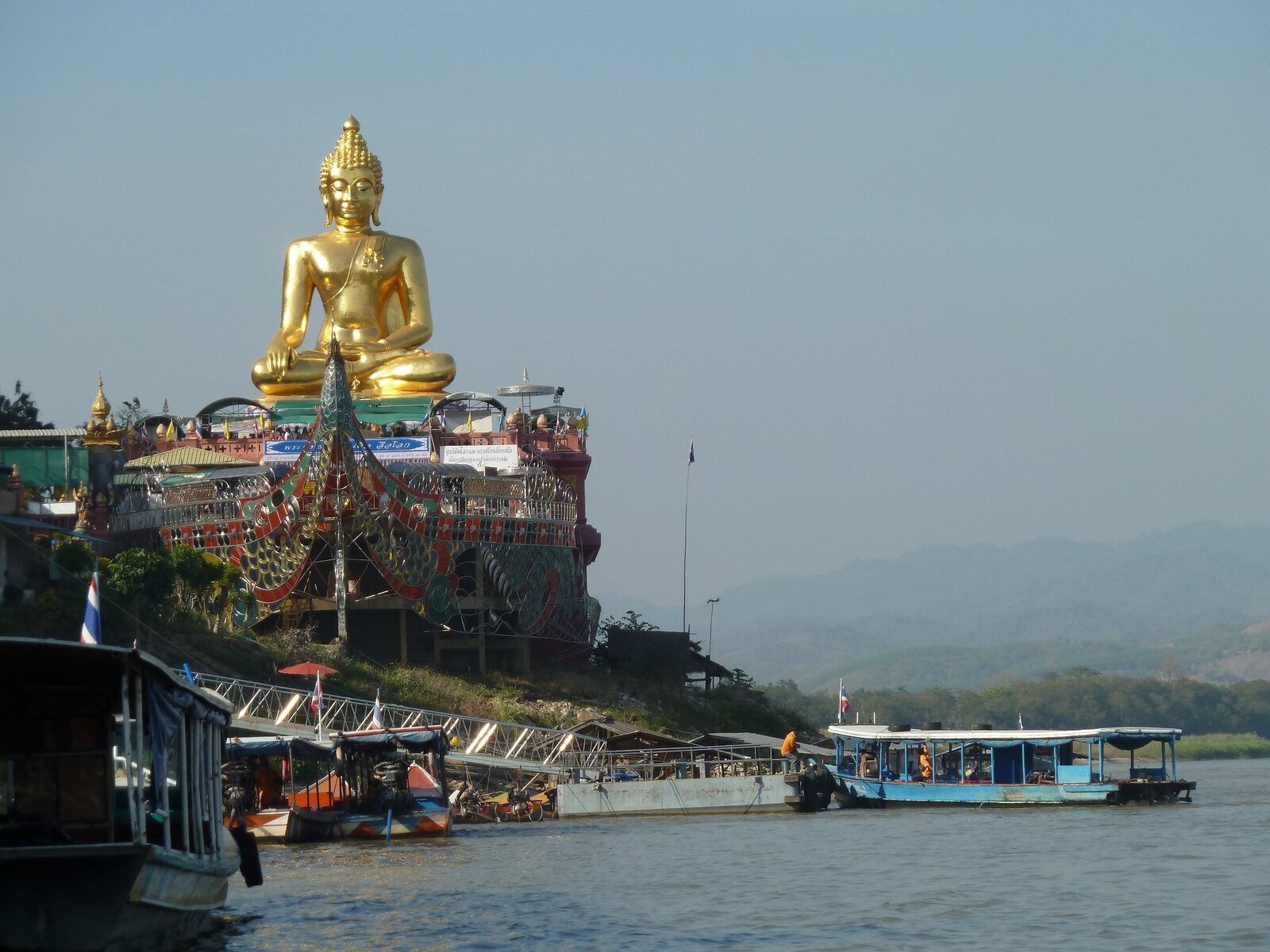
The Golden Triangle
Where the Ruak meets the Mekong and three countries meet with it, best understood from the water at the end of the day.
Where
Chiang Rai
Best time
November to February, when the river haze lifts and the evenings turn cool.
The Golden Triangle is a confluence before it is anything else: the Ruak comes down out of Myanmar, the Mekong comes down out of China, and where they join, Thailand, Laos and Myanmar all have a bank. Stand on the Thai side at dusk and you can see all three at once, which is the whole of the geography and about a tenth of the interest.
The name belongs to the opium economy that ran through these hills for most of the twentieth century, and the Thai side has done something unusual with that inheritance: rather than trading on it as folklore, it built a serious museum and a development programme. The poppy is gone from the Thai slopes. What replaced it is on the tables of Chiang Rai.
The river remains, wide and silt-brown and busy with Chinese barges, and it is best taken slowly in the last hour of light.
What the Hall of Opium actually says
The museum above the confluence, built under the Mae Fah Luang Foundation, is not the curiosity cabinet the setting might lead you to expect. It begins with the poppy as medicine, moves through the opium wars and is unsparing about British and European responsibility for the trade, then follows the drug into the hill economies of the twentieth century and into modern addiction, ending somewhere considerably less comfortable than where it started.
The design is deliberate and cinematic, opening with a long tunnel before you see a single object. Give it two hours. It is the reason the Golden Triangle is worth a day rather than a photograph, and it is the piece of the region most visitors skip.
The river at the end of the day
A private longtail from Sop Ruak takes you out onto the confluence itself, where the silt-brown Mekong and the paler Ruak run side by side for a distance before mixing. The Lao bank is close enough to read signage on; the Burmese bank is closer still. Cargo barges come down from Yunnan, low in the water and unhurried.
The hour before sunset is when the haze on the water goes gold and the temperature becomes bearable, and it is also when the day boats have finished. We keep this for the end of the afternoon deliberately. In November to February the evenings turn genuinely cool on the river and the visibility across to the far ridges is at its best.
Doi Tung, and what replaced the poppy
An hour or so west, the Doi Tung development project turned poppy hillsides into arabica coffee, macadamia and cut flowers over the course of a generation, alongside the late Princess Mother's hillside residence and the Mae Fah Luang gardens. It is the practical answer to the museum's question, and seeing the two on the same journey is what makes either of them land.
The villa is a modest Lanna-Swiss chalet rather than a palace, which tells you something in itself. The gardens are cool-climate and at their best from November. Coffee grown on the slope is served at the top of it, and it is genuinely good coffee, which was rather the point of the exercise.
How We Visit
Our way in
We build the Golden Triangle as a full day rather than a photo stop, usually from a base in Chiang Rai, and we run it backwards from most itineraries: the Hall of Opium in the cool of the morning while the day-trippers are at the viewpoint, Doi Tung and lunch in the middle, and the river last, in a private longtail in the final hour of light. Your guide can handle the twentieth-century politics of these borders properly, including the parts that are not flattering to anyone. We do not do the cross-border souvenir run; it adds nothing but a queue.
Questions
What travellers ask
Where is the Golden Triangle in Thailand?
At Sop Ruak in Chiang Rai province, in the far north, where the Ruak river joins the Mekong and the borders of Thailand, Laos and Myanmar meet. It is roughly an hour by road north of Chiang Rai town and around four hours from Chiang Mai. The Thai bank carries the viewpoint, the Hall of Opium museum and the boat landings for the confluence.
Is the Golden Triangle worth visiting?
Yes, if you give it a day rather than a viewpoint stop. The confluence itself is a ten-minute photograph. What justifies the journey is the Hall of Opium, a genuinely serious museum on the history of the drug trade, the private boat on the Mekong in the last of the light, and the Doi Tung development project an hour away, where the poppy economy was replaced with coffee and macadamia.
What is the best time of year for the Golden Triangle?
November to February. The river haze lifts, the evenings on the water turn cool, and the ridges across in Laos and Myanmar are visible rather than washed out. March and April bring agricultural burning haze across the whole of the north, which flattens the long views. The Doi Tung gardens are also at their best in those cool-season months.
Journeys That Include This
Ask about The Golden Triangle
It sits inside a journey we already run, and it fits just as easily into one written from scratch around your dates.
Nearby