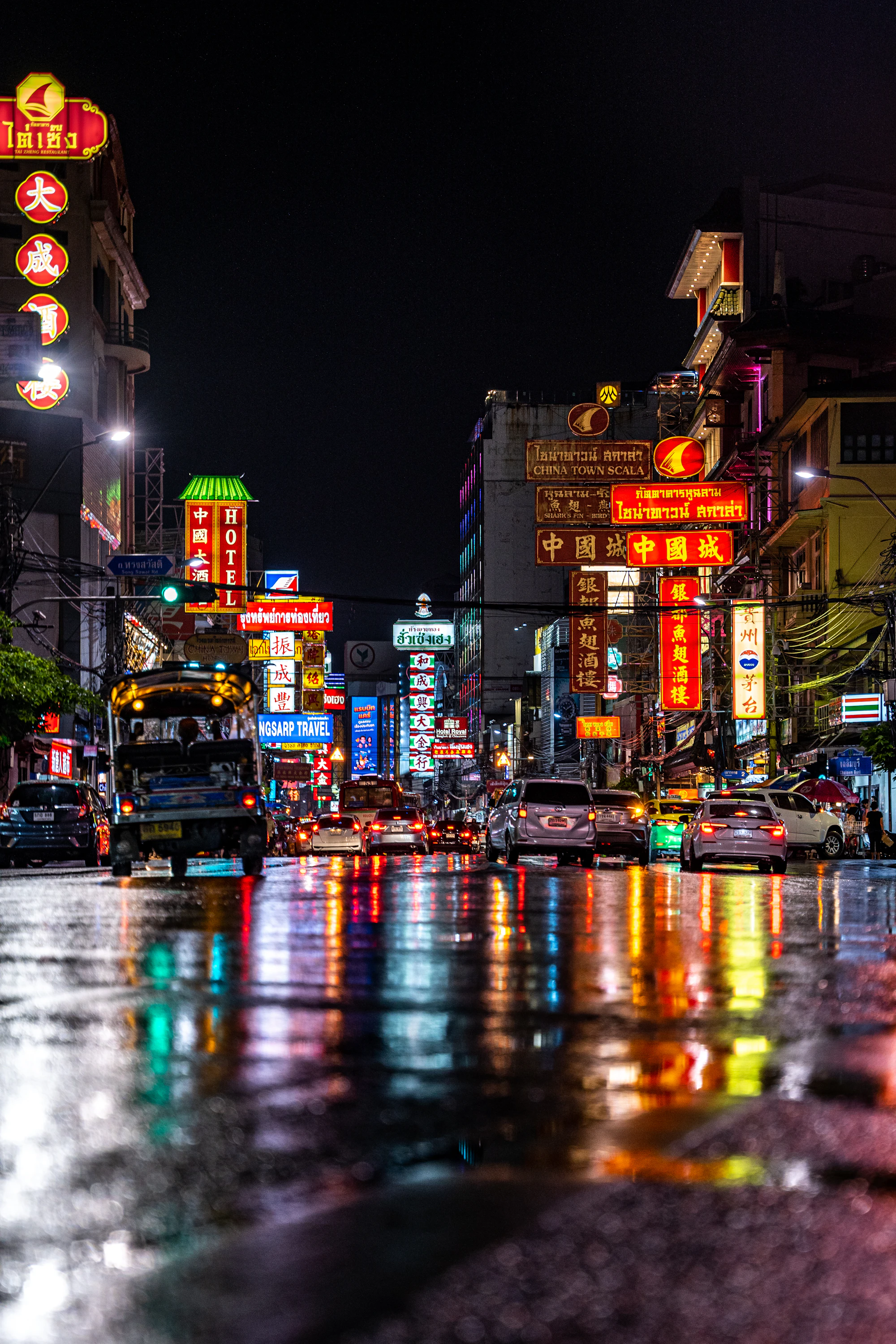
Yaowarat
Chinatown
Bangkok’s Chinatown trades gold by day and cooks on the pavement by night. We walk it after dark with someone who knows which stalls still deliver.
Where
Bangkok
Best time
After nightfall, and best avoided in the week of Chinese New Year unless that is why you came.
Yaowarat is what happened when the Chinese community living on the site of the Grand Palace was asked to move, in 1782, and settled downstream at Sampheng. The lane they were given is still there, still barely wider than two people, still selling everything. Yaowarat Road itself came a century later, cut through the quarter in the reign of Rama V, curving because the ground did.
By day it is the centre of Thailand’s gold trade: shopfronts in red and gold, glass cases of chains sold by weight at the day’s rate, and a queue at the counter that has nothing to do with any tourist season.
After dark the shutters come down and the street kitchens take the pavement in front of them — charcoal, woks over gas jets loud enough to talk over, plastic stools, and a smell of frying garlic that reaches you several streets away.
Eating standing up, and what to order
The rule on Yaowarat is that specialists beat menus. A stall that has cooked one thing for forty years — oyster omelette, crab curry, duck over rice, toasted bread with custard — will do it better than any restaurant with a laminated card, and the queue in front of it is the only review that matters. Portions are small and priced so that you eat at five or six places in an evening rather than one. Seating is a plastic stool if you are lucky. We eat in a loop rather than sitting down, and finish with something cold on a side lane, because the heat coming off the woks is considerable and is part of the evening rather than a fault in it.
The gold Buddha nobody knew was gold
At the western end of Yaowarat stands Wat Traimit, which holds a seated Buddha of some five and a half tonnes of solid gold. For most of its life nobody knew. The image had been covered in stucco, almost certainly to hide it from Burmese armies, and sat for generations as an unremarkable plaster Buddha of no particular value. In 1955 it was being moved when the casing cracked and the metal showed through. It is Sukhothai work of the thirteenth or fourteenth century, which places its making some four hundred years before the plaster went on and around five hundred before anyone found out.
The ninth lunar month, and the week to avoid
For nine days in the ninth Chinese lunar month, usually falling in late September or October, Yaowarat turns yellow. Flags go up over every stall observing the vegetarian festival, and the street cooks without meat, dairy, eggs or the pungent vegetables, which produces some of the most inventive food of the year rather than the least. Shrines run processions and rites through the quarter throughout. It is a good time to come if the idea appeals, and a poor one if you had set your heart on the duck. Chinese New Year is the other date to know: spectacular, and effectively impassable.
How We Visit
Our way in
We walk Yaowarat after nightfall with a guide who eats here rather than points at things — someone who can tell you which stall has held its standard for four decades and which has been coasting since it appeared on television. We usually begin on a side lane, work into the main road, and finish in Talat Noi. Nothing is pre-ordered, because the choosing is the point. If a family would rather not stand on a pavement, we take a table at a proper Teochew restaurant and bring the street food to it.
Questions
What travellers ask
What is the best time to visit Yaowarat, Bangkok’s Chinatown?
After dark, from about seven in the evening, when the gold shops close and the street kitchens take over the pavements. Daytime Yaowarat is a working gold and wholesale district and much less rewarding on foot in the heat. Avoid the week of Chinese New Year unless the festival is the reason you came, because the road becomes impassable on foot.
Is street food in Bangkok’s Chinatown safe to eat?
Generally yes, and safer than it looks. Choose stalls with a queue and high turnover, where food is cooked to order over heat in front of you rather than sitting warm. Be more cautious with pre-cut fruit and iced drinks from stands you cannot see being prepared. We take clients to vendors we have used for years, which removes most of the guesswork.
How much time do you need in Yaowarat?
About three hours in an evening: long enough to eat at five or six places, look into a shrine or two and walk down Sampheng Lane, without the heat wearing you down. Add an hour if you want Wat Traimit and the Golden Buddha, which is better seen in daylight before dinner rather than tacked on afterwards.
Journeys That Include This
Ask about Yaowarat
It sits inside a journey we already run, and it fits just as easily into one written from scratch around your dates.
Nearby