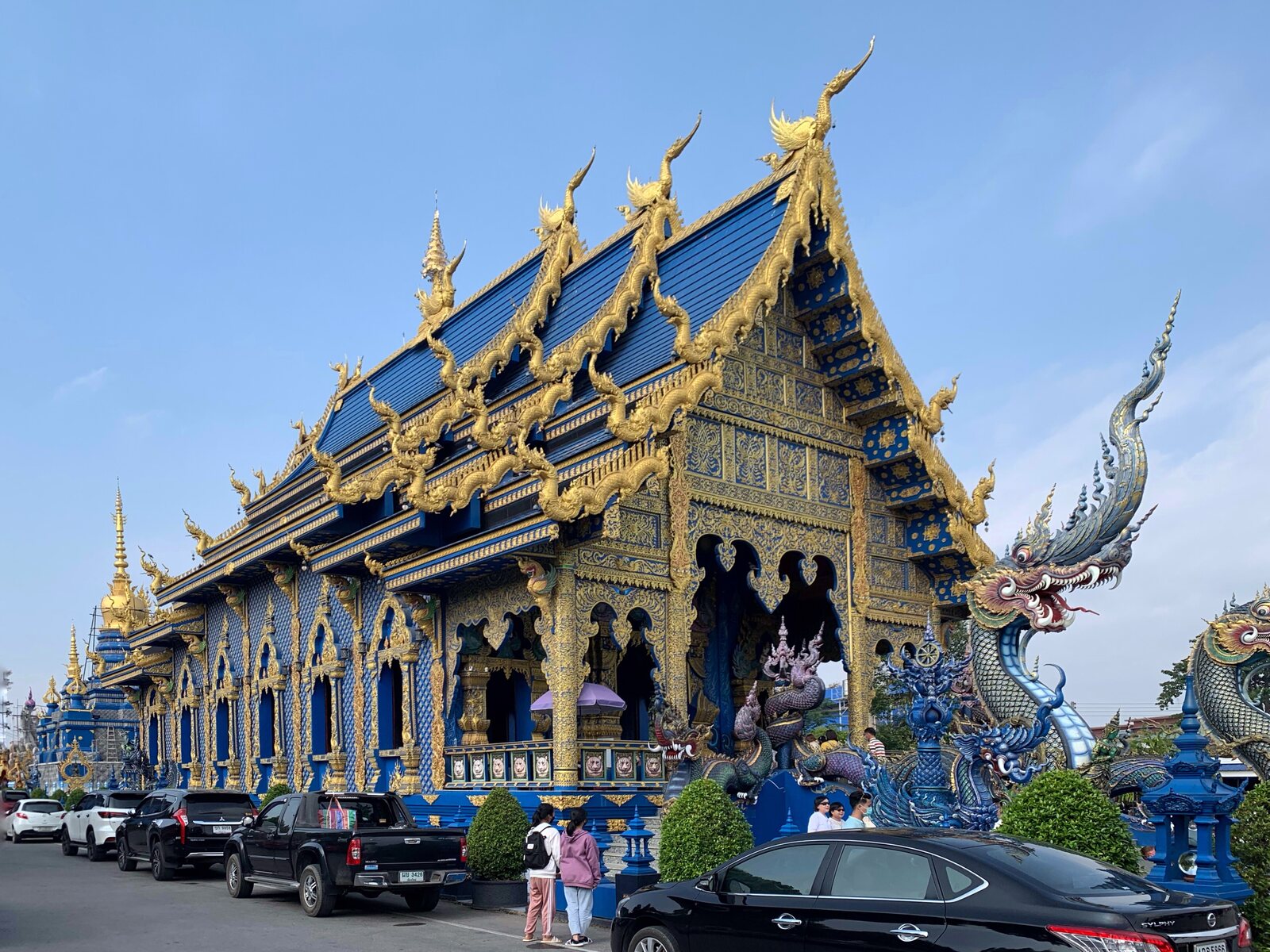
Wat Rong Suea Ten
The Blue Temple
The Blue Temple is the White Temple's answer rather than its imitation: indigo and gold, a luminous white Buddha, and a ceiling worth lying down for.
Where
Chiang Rai
Best time
November to February. The blue reads deepest in flat morning light, before the tour coaches arrive from Chiang Mai.
Wat Rong Suea Ten sits on the northern edge of Chiang Rai, and it is a young building — completed around 2016 on ground where an older temple had stood abandoned for something close to a century. The artist behind it, Putha Kabkaew, trained under Chalermchai Kositpipat at Wat Rong Khun, and the lineage is legible: the same appetite for total decoration, the same refusal of restraint, applied at the other end of the spectrum.
Where the White Temple is glare, this is saturation. Every surface inside is sapphire and cobalt, veined with gold, and the effect is closer to being inside a jewel than inside a building. At the far end sits a tall white seated Buddha, deliberately the only pale thing in the room, so that the eye has nowhere else to go.
It is small, it takes twenty minutes, and it stays with people longer than that.
Why the blue
Blue is not a traditional palette for a Thai ubosot, and the choice is doing work. The artist has spoken of it as the colour of the dharma and of the sky — of limitlessness rather than of any particular thing. Practically it also solves the problem of following the White Temple: a second exercise in white would have been a copy, whereas the inversion reads as a reply.
The gold is used sparingly against it, as line rather than as mass, so the ornament looks drawn rather than applied. Look up: the ceiling is the best part of the room, a continuous painted vault that most visitors miss entirely because they are photographing the Buddha at eye level.
The tiger that gave it its name
Rong Suea Ten means, roughly, the house of the dancing tiger. Local memory holds that tigers once crossed the stream here in leaps, which gave the district its name long before there was a temple to attach it to. The original temple on the site was left derelict for generations and had largely returned to ground before the present building was raised over it.
That continuity matters to how the place is regarded locally. It is not a monument dropped onto empty land for visitors; it is a village temple rebuilt, on its own ground, by an artist from the district. People come here to make merit, not only to look, and the atmosphere is noticeably more devotional than at its famous neighbour.
Pairing it with the White Temple
The two sit on opposite sides of Chiang Rai, roughly half an hour apart with traffic, and almost every itinerary in the north puts them in the same day. Most do it badly: White Temple at eleven with the coaches, Blue Temple at one, both in a rush, a long drive back in the afternoon.
Done the other way round — Wat Rong Khun at opening, a slow breakfast, the Blue Temple mid-morning while the coaches are still where you have just been — it becomes one unhurried morning with a real argument running through it, from the ascetic exterior of the first to the immersive interior of the second. Two temples properly, rather than four badly, is the whole principle.
How We Visit
Our way in
We treat the Blue Temple as the second half of a Chiang Rai morning rather than a stop on a list, arriving after the White Temple has been done at opening and while the tour traffic is still behind us. A private car and driver means the half-hour between them costs nothing in stress. Your guide can place Putha Kabkaew within the northern art lineage rather than simply announcing that the ceiling is blue. Modest dress and bare feet inside, as at any working temple. Where you would prefer it, we overnight in Chiang Rai and take both at first light on consecutive days.
Questions
What travellers ask
How far is the Blue Temple from the White Temple?
They sit on opposite sides of Chiang Rai, roughly half an hour apart by road depending on traffic. Wat Rong Khun is south of the city and Wat Rong Suea Ten is on the northern edge. Both can be done comfortably in a single morning if you start at the White Temple as it opens and move to the Blue Temple afterwards, which keeps you ahead of the coach groups all day.
When was the Blue Temple built?
It was completed around 2016, making it one of the youngest significant temples in Thailand. It was designed by Putha Kabkaew, an artist from the district who trained under Chalermchai Kositpipat at the White Temple. The site itself is much older: an earlier village temple stood there and had been abandoned for roughly a century before the present ubosot was raised over the ground.
Is the Blue Temple worth visiting if you have already seen the White Temple?
Yes, because it is a deliberate counterpoint rather than a repetition. The White Temple is an exterior experience of glare and mirrored plaster; the Blue Temple is an interior one, wholly saturated in indigo and gold with a single luminous white Buddha at the end of the room. It takes about twenty minutes, sits half an hour away, and is noticeably quieter and more devotional.
Journeys That Include This
Ask about Wat Rong Suea Ten
It sits inside a journey we already run, and it fits just as easily into one written from scratch around your dates.
Nearby