Khao Yai National Park
Thailand’s first national park, three hours from Bangkok: elephants on the roads at dusk, hornbills over the canopy, and vineyards on its northern edge.
Where
Nakhon Ratchasima
Listed
UNESCO World Heritage, inscribed 2005
Best time
November to February for clear trails and cool mornings; the green season for the waterfalls at full voice.
Khao Yai was declared in 1962, the first national park in Thailand, and it protects more than two thousand square kilometres of the Phanom Dong Rak range — evergreen forest, grassland, salt licks and a series of waterfalls. It forms the western end of the Dong Phayayen–Khao Yai Forest Complex, inscribed by UNESCO in 2005, and one of the few blocks of habitat in this part of Asia still large enough to hold a viable elephant population.
Around three hundred wild elephants live here, and they use the roads, particularly at dusk. Gibbons call at first light from the canopy, a rising whoop that carries a long way through the trees and is the sound most people take home. Hornbills nest in the forest, and a great hornbill crossing an open valley makes a noise like a slow aircraft.
It is roughly three hours from Bangkok, and the hills on its northern edge have become a small wine region, which gives the trip an unexpected second half.
First light and last light
Wildlife here is a matter of hours rather than luck. Between dawn and about eight the gibbons are calling, the hornbills are moving to feed and the grassland edges hold deer. From late afternoon until the gate closes the elephants come down to the salt licks and onto the roads. The middle of the day is hot, still and largely empty of anything but macaques and the visitors who arrived at eleven. Watchtowers over the salt licks let you sit and wait, which is how most sightings actually happen rather than by driving about. Night drives run inside the park under ranger supervision and turn up civets, porcupines and, occasionally, an elephant at close range.
The waterfalls, and the one from the film
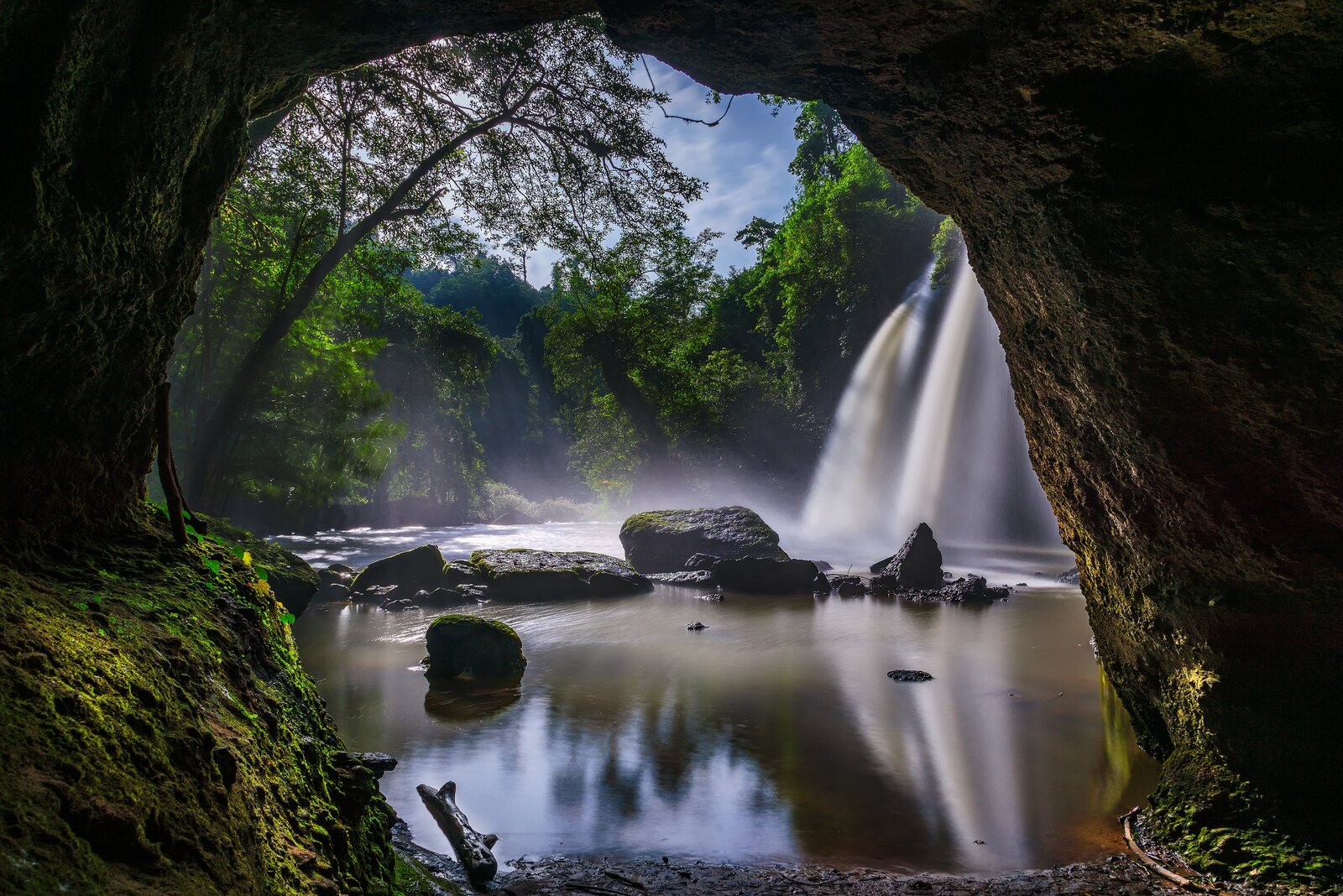
Haew Suwat is the fall used in the film of The Beach, which draws a steady traffic of people photographing it from the viewpoint and then leaving. Haew Narok, deeper into the park, is the far bigger drop, with a long stair down to see it properly. Both run hardest in the green season, from June into October, when the forest is at its loudest and the trails are wet. That is also leech season on the walking routes, which is a genuine nuisance rather than a danger, and is dealt with by proper socks and a little patience.
Wine on the northern edge
The hills around Pak Chong, on the park’s northern side, carry vineyards planted from the 1990s onwards — part of what the trade calls new-latitude wine, grown at around four hundred metres, with a harvest in January and February rather than September. The results are honest rather than remarkable: crisp whites, and reds from Shiraz and Tempranillo that suit the food here better than they suit a blind tasting. Several estates receive visitors properly, with a cellar walk and a lunch worth the table on its own. It makes a civilised afternoon after a dawn start, and it is why families with mixed appetites tend to do well in Khao Yai.
How We Visit
Our way in
We stay outside the gates and go in before they open, which is the whole trick — the first two hours are worth the rest of the day combined. Our guide is a naturalist with a scope rather than a driver with a checklist, and we use the salt-lick towers and the quieter trails instead of the roadside stops. Afternoons stay flexible: a second drive at dusk, a waterfall, or lunch at a vineyard on the northern edge. Elephants are wild and nothing is promised. What we can promise is being in the right places at the right hours.
Questions
What travellers ask
Can you see wild elephants in Khao Yai?
Yes, and Khao Yai is the most reliable place in Thailand to do so: roughly three hundred elephants live in the park, and they use the roads and salt licks, particularly around dusk and after dark. Sightings are never guaranteed and no responsible operator will promise one. Stay in the vehicle, keep well back, and follow the rangers — these are wild animals on their own ground.
How far is Khao Yai from Bangkok?
About a hundred and eighty kilometres north-east, or roughly two and a half to three hours by road, which makes it the closest serious wildlife to the capital. Most people stay a night or two on the Pak Chong side rather than attempting it in a day, because the park is worth seeing at dawn and at dusk and both are impossible on a return drive.
What is the best time of year to visit Khao Yai?
November to February, for cool mornings, dry trails and the easiest walking. The green season, roughly June to October, brings the waterfalls to full volume and the forest to its most alive, at the cost of mud, leeches and afternoon rain. Wildlife is present all year; it is the comfort and the trail conditions that change with the season.
Journeys That Include This
Ask about Khao Yai National Park
It sits inside a journey we already run, and it fits just as easily into one written from scratch around your dates.
Nearby